
Kyphoplasty
- Overview
Reviewed on Thursday 6 August 2026 by a General Practitioner (GP).
A vertebral compression fracture doesn’t just hurt, it can limit how you stand, walk and carry out everyday tasks. Kyphoplasty is one of the treatments used to stabilise these fractures, but it isn’t suitable for everyone. Only a spinal specialist can confirm whether this procedure is appropriate for your type of fracture.
What is kyphoplasty?
Kyphoplasty, also known as balloon kyphoplasty, is a minimally invasive procedure used to treat vertebral compression fractures, which are small breaks in the spine that cause the vertebra to collapse. These fractures are most commonly caused by osteoporosis, but can also occur after trauma or, less commonly, due to underlying conditions affecting bone strength.
During kyphoplasty, your consultant uses a tiny incision to access the fractured vertebra and create space inside it using a small balloon. This space is then filled with medical‑grade bone cement to stabilise the bone and reduce pain.
Types of kyphoplasty
Kyphoplasty isn’t a single, one‑size‑fits‑all procedure. There are several techniques your consultant may consider, each designed to stabilise a fractured vertebra in slightly different ways. The right approach depends on the type of fracture, your bone quality, your symptoms, and your overall health, and this decision can only be made by a spinal specialist after reviewing your scans.
Here’s an overview of the main types:
-
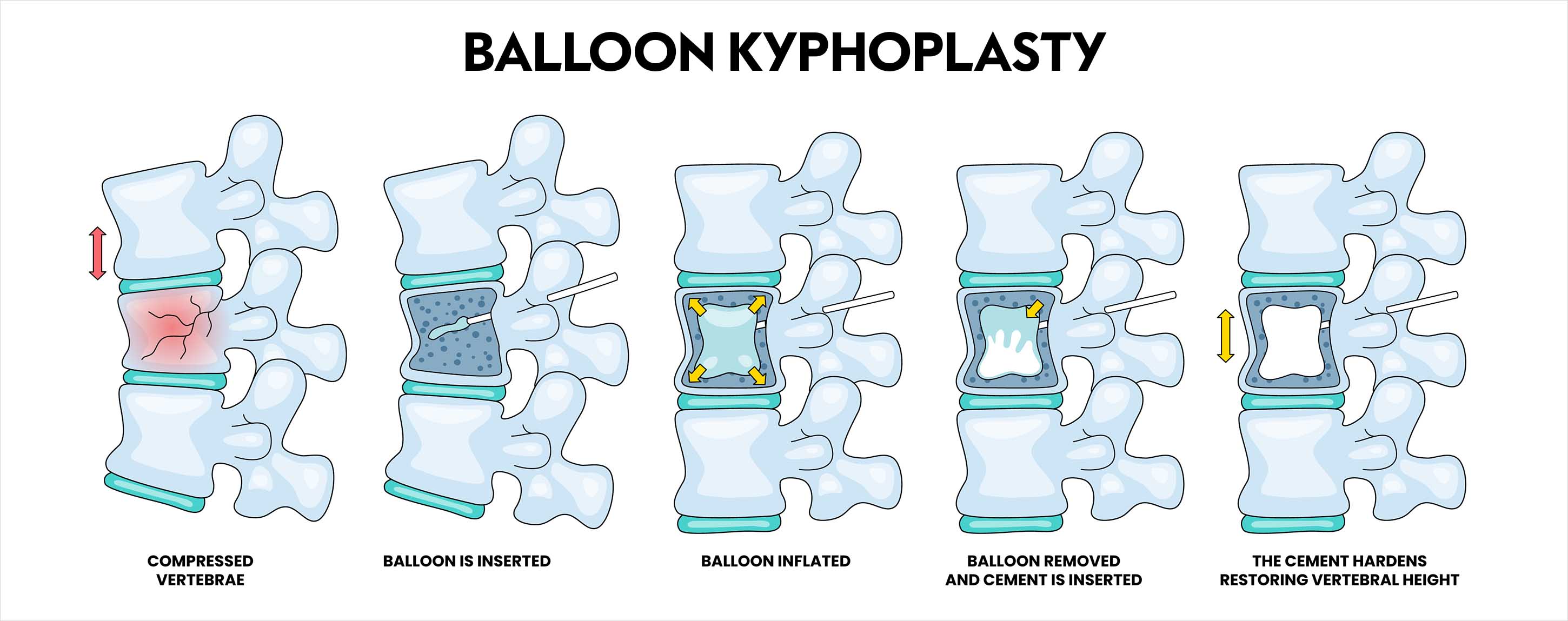
Balloon kyphoplastyThis is the traditional and most widely used method. A small balloon (called a bone tamp) is inserted into the collapsed vertebra and gently inflated to create space and, in some cases, restore lost height. The balloon is then removed and the cavity is filled with bone cement to stabilise the fracture.
Why a surgeon may choose it:- Helps restore vertebral height
- Creates a controlled space for cement
- Often provides rapid pain relief.
-
Radiofrequency‑assisted kyphoplastyInstead of using a balloon, this technique uses radiofrequency energy to warm and thicken the bone cement before it’s injected. The cement becomes more viscous, allowing the surgeon to place it with greater precision.
Why a surgeon may choose it:- Allows highly controlled cement placement
- May reduce the risk of cement leakage
- Useful for certain fracture patterns.
-
Expandable implant kyphoplastyIn this approach, a tiny expandable implant is inserted into the fractured vertebra. Once expanded, it helps restore height and create a stable internal structure. Cement is then added around the implant to secure the repair.
Why a surgeon may choose it:- Provides internal scaffolding for the vertebra
- May offer better height restoration in selected cases
- Useful for complex or unstable fractures.
Kyphoplasty is not a procedure you self‑select. The type of kyphoplasty, or whether kyphoplasty is appropriate at all, can only be determined by a spinal consultant after reviewing:
- Your MRI or CT scans
- The age and pattern of the fracture
- Your bone density
- Your symptoms
- Your overall health.
In some cases, vertebroplasty or non‑surgical management may be more suitable. Your consultant will guide you to the safest and most effective option for your spine.
What are the alternatives to kyphoplasty?
Not everyone with a vertebral compression fracture will need kyphoplasty. In many cases, symptoms improve with time and conservative treatment. Your consultant will assess your scans, symptoms and overall health to determine whether kyphoplasty is appropriate, or whether another approach may be safer or more effective.
Here are the main alternatives your specialist may discuss with you:
-
Pain‑relief medicationSimple painkillers, anti‑inflammatory medication or short‑term prescription pain relief can help manage symptoms while the fracture heals naturally. This is often the first step, especially if the fracture is stable and your pain is gradually improving.
Best for:- Mild to moderate pain
- Stable fractures
- Early symptom management.
-
BracingA spinal brace can help support the back, reduce movement around the fracture and ease pain during healing. Bracing is usually temporary and may be recommended for several weeks.
Best for:- People who need extra support while the bone heals
- Those who cannot undergo a procedure.
-
PhysiotherapyOnce your pain begins to settle, physiotherapy can help improve mobility, strengthen the supporting muscles and reduce stiffness. It also plays an important role in preventing future fractures by improving posture and balance.
Best for:- Recovery after the initial healing phase
- Improving long‑term mobility and confidence.
-
Activity modificationYour consultant may recommend temporarily avoiding activities that strain the spine, such as heavy lifting, bending or twisting, while the fracture heals. Gentle walking is usually encouraged to maintain circulation and prevent stiffness.
Best for:- Early healing
- Reducing pain flare‑ups.
-
VertebroplastyVertebroplasty is a minimally invasive procedure similar to kyphoplasty, but without the use of a balloon. Instead, bone cement is injected directly into the fractured vertebra to stabilise it.
Best for:- Certain fracture patterns
- Cases where height restoration is not required
- Patients unsuitable for balloon inflation.
Your consultant will discuss all appropriate options with you.
The decision between kyphoplasty, vertebroplasty, or conservative treatment depends on:
- The age and pattern of your fracture
- Your level of pain
- Your bone density
- Your overall health
- MRI or CT scan findings.
Some fractures heal well without intervention. Others may benefit from stabilisation. Your consultant will guide you to the safest and most effective option for your spine.
Kyphoplasty vs vertebroplasty: what’s the difference?
Both procedures stabilise a fractured vertebra using bone cement, but they differ in technique:
- Kyphoplasty uses a balloon to create space and may restore some lost vertebral height.
- Vertebroplasty, on the other hand, injects cement directly into the fractured bone without creating space first.
Neither procedure is automatically “better”; the right choice depends entirely on your fracture pattern, symptoms and imaging. Your consultant will determine which procedure, if any, is appropriate.
How will I know if I need kyphoplasty or vertebroplasty?
Only a specialist can make this decision. They will assess:
- Your symptoms
- Your level of pain
- MRI or CT scan findings
- How recent the fracture is
- Your bone quality
- Your overall health.
Some fractures heal well without intervention. Others may benefit from stabilisation. Your consultant will guide you based on your individual case.
What conditions can kyphoplasty treat?
Kyphoplasty is primarily used to treat vertebral compression fractures (VCFs).
What is a vertebral compression fracture?
A VCF occurs when a vertebra collapses, usually due to weakened bone. This can cause:
- Sudden, severe back pain
- Difficulty standing or walking
- Loss of height
- Stooped posture.
What causes vertebral compression fractures?
- Osteoporosis (most common cause)
- Trauma or injury
- Certain cancers or bone‑weakening conditions.
How serious is a vertebral compression fracture?
If untreated, a VCF can lead to:
- Persistent pain
- Reduced mobility
- Progressive spinal curvature
- Increased risk of further fractures.
Who is at risk?
- People with osteoporosis
- Post‑menopausal women
- Older adults
- People on long‑term steroid medication
- Those with low bone density or previous fractures.
When should you consider kyphoplasty?
Kyphoplasty may be considered when:
- Pain from a compression fracture is severe or persistent
- Pain limits daily activities
- Imaging confirms a suitable fracture
- Non‑surgical treatments haven’t helped.
Only your consultant can help determine this.
Who is suitable?
You may be suitable if:
- You have a confirmed vertebral compression fracture
- Your pain is significant
- The fracture is relatively recent
- You are in good general health.
Who is not suitable?
Kyphoplasty may not be recommended if:
- The fracture is old and fully healed
- There is spinal canal compromise
- You have an active infection
- Bone quality is too poor for cement stabilisation.
Is there a time limit for kyphoplasty?
Kyphoplasty is generally most effective when performed within 6–8 weeks of the fracture. However, suitability varies, and your consultant will determine the right timing.
How do I prepare for kyphoplasty?
Preparing for kyphoplasty is usually straightforward, but taking a little time to get organised can make the day of your procedure feel calmer and more predictable. Your consultant and nursing team will guide you through everything you need to do, but here’s what preparation typically involves.
Most people will have:
- A pre‑procedure assessment
- Blood tests or imaging to confirm the diagnosis
- A review of current medications
- Fasting instructions if you’re having a general anaesthetic
- Plans for transport home, as you won’t be able to drive afterwards.
These steps help ensure the procedure is safe and tailored to your individual needs.
What should I bring on the day?
To make the day run smoothly, it’s helpful to bring:
- Comfortable, loose‑fitting clothing
- A list of your current medications
- Any mobility aids you normally use (e.g., walking stick)
- A responsible adult to take you home, as you cannot drive after the procedure
- Reading glasses, if you need them for signing forms
- A phone charger if you’re staying overnight.
What happens during a kyphoplasty?
Kyphoplasty is a minimally invasive procedure, and for most people it feels far less daunting than traditional spinal surgery. Your consultant will talk you through every step beforehand, but here’s what the experience typically looks like.
Kyphoplasty is usually performed under general anaesthetic, so you’ll be asleep and comfortable throughout. The procedure typically takes 1–2 hours, depending on how many vertebrae are being treated.
During the procedure
Once the general anaesthetic kicks in and you’re asleep, the surgical team will position you safely and begin the procedure. Although the incisions are small, the technique is precise and guided by real‑time imaging.
Here’s what happens:
- You will lie on your stomach so the surgeon can access the spine
- A small incision is then made in your back
- Using X‑ray guidance, a hollow needle is passed into the fractured vertebra
- A tiny balloon (bone tamp) is inserted and gently inflated
- The balloon creates a space and may restore some lost height
- The balloon is then removed
- Medical‑grade bone cement is injected into the space to stabilise the vertebra
- The incision is then closed with a small dressing.
The cement hardens within minutes, creating immediate internal support for the fractured bone.
Is kyphoplasty painful?
You shouldn’t feel any pain during the procedure because you’ll be under general anaesthetic but after the procedure it’s normal to feel:
- Mild soreness at the incision site
- A bruised or achy sensation in the back.
These symptoms usually settle quickly and can be managed with simple pain relief.
Immediately after the procedure
Once the procedure is complete:
- You’ll rest lying flat for 1–2 hours while the cement fully sets
- Your blood pressure, heart rate and comfort levels will be monitored
- You’ll be offered something to eat and drink once you’re fully awake
- You’ll need someone to drive you home.
Some people feel an improvement in their back pain as soon as they stand up.
How long does it take to recover after kyphoplasty?
Kyphoplasty is often performed as a day case, meaning most people go home the same day. In some cases, an overnight stay may be recommended, for example, if multiple vertebrae were treated or if you have other medical conditions.
In the first 24 hours
Your body needs time to recover from the anaesthetic and the procedure itself. Most people are advised to:
- Rest and avoid strenuous activity
- Keep movements gentle and comfortable
- Expect mild soreness around the incision
- Use an ice pack wrapped in a towel to ease discomfort.
Short walks around the house are fine; movement will help with your circulation and help reduce stiffness.
Pain relief
Many people notice a reduction in their back pain immediately, especially if the fracture was the main source of discomfort. For others, the improvement is more gradual and becomes noticeable over several days.
Simple pain relief is usually enough during the early recovery period.
Returning to daily activities
Your consultant will give personalised advice, but general guidance often includes:
- Light activities: After 24 hours is best
- Desk‑based work: Can usually be resumed within a few days
- Driving: Once you can move comfortably and safely, you’re able to resume driving, but your consultant will confirm.
- Exercise: Gentle walking is encouraged; avoid heavy lifting for up to 6 weeks
- Flying: Check with your consultant, especially if travelling soon after the procedure.
Most people find they can return to normal routines fairly quickly, as long as they avoid anything that strains the spine.
What to avoid after kyphoplasty
For the first few weeks, you may be advised to avoid:
- Heavy lifting
- High‑impact exercise
- Twisting or bending movements
- Long periods of sitting in the first few days.
These precautions help protect the treated vertebra while the cement fully integrates with the bone.
What are the benefits of kyphoplasty?
Kyphoplasty aims to:
- Reduce pain caused by the fractured vertebra
- Stabilise the bone, preventing further collapse
- Improve mobility and help you return to daily activities
- Reduce reliance on pain medication
- Restore some lost vertebral height (in selected cases)
- Improve posture by supporting the spine’s natural alignment.
How soon will I feel the benefits?
Some people feel relief immediately; others notice improvement over several days as inflammation settles.
How long do results last?
Results are typically long‑lasting, especially when combined with:
- Osteoporosis management
- Bone‑strengthening medication
- Lifestyle changes that support bone health.
What are the risks and complications of kyphoplasty?
Kyphoplasty is considered a safe procedure, but all medical treatments carry some risks.
General risks may include:
- Pain
- Bleeding
- Infection.
Procedure‑specific risks may include:
- Nerve irritation
- Numbness or tingling
- Cement leakage
- No improvement in pain.
Your consultant will discuss these risks with you and explain how they are minimised during the procedure.
What is the success rate of kyphoplasty?
Kyphoplasty has a high success rate for reducing pain and improving mobility in people with suitable fractures. Many patients report a rapid return to daily activities and a significant improvement in quality of life.
How much does a kyphoplasty cost at Nuffield Health?
For pricing information, please contact your local Nuffield Health hospital. The hospital or your healthcare team will give you a fixed all-inclusive price for the treatment following your initial consultation.
FAQs
-
Can kyphoplasty be repeated if I fracture another vertebra?
Yes, if you sustain a new fracture, your consultant may recommend another procedure.
-
What is the bone cement used in kyphoplasty?
A medical‑grade acrylic cement is used and it’s designed to harden quickly and stabilise the bone.
-
Is there a risk of cement leakage during kyphoplasty?
Leakage is uncommon, and imaging guidance helps minimise the risk.
-
Will I need to wear a back brace after kyphoplasty?
Not usually, your consultant will advise based on your fracture.
-
Will I need physiotherapy after kyphoplasty?
Some people benefit from physiotherapy to improve mobility and posture – your consultant will discuss this with you.
-
Will kyphoplasty help with my posture or height loss?
It may restore some lost height, but results can vary.
Ways to pay
Nuffield Health promise
Our prices are all-inclusive. We will equal any comparable price. There are no time limits on your aftercare.
Paying for yourself
There are no hidden costs in our treatment prices. The price you see is the price you pay.
Find out morePersonal medical loan
Spread the cost of your treatment with a 10, 12 or 24 month 0% personal medical loan.
Find out moreMedical insurance
We work with you and your insurance provider to get you the treatment you need quickly
Find out more