
Partial knee replacement surgery at Leeds Hospital
- Overview
Partial knee replacement, also known as unicompartmental knee replacement (UKR), treats arthritis affecting a single compartment of the knee while preserving healthy bone and tissue. At Nuffield Health Leeds Hospital, our experienced orthopaedic surgeons perform both traditional and robotic-assisted partial knee replacement surgery, helping to relieve knee pain, improve mobility and support a faster recovery where appropriate.
What is partial knee replacement?
As its name suggests, partial knee replacement is a surgical procedure used to replace part of the knee joint, rather than the whole joint.
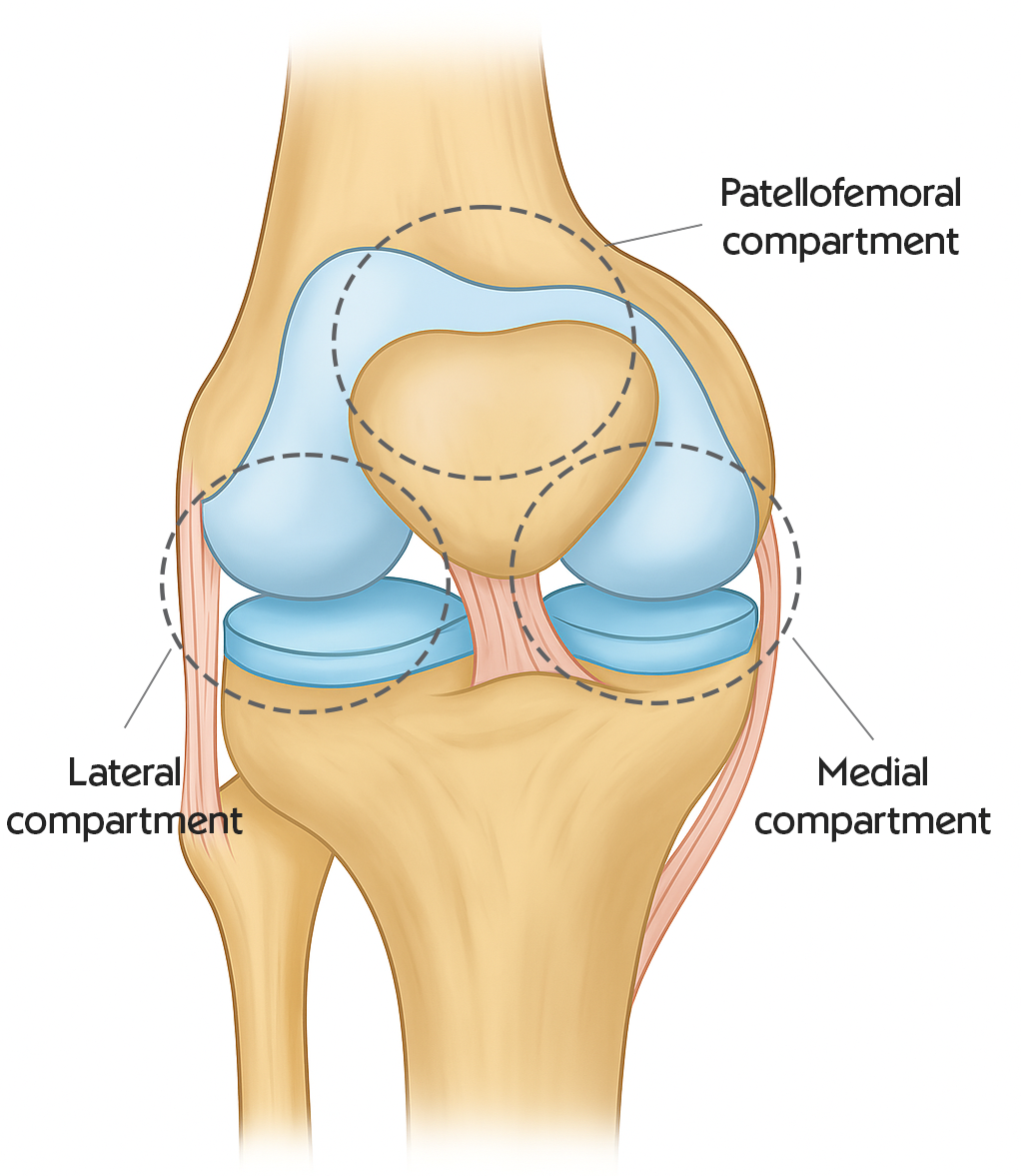
The knee joint is made up of three compartments. These are known as:
- The medial compartment: located on the inner side of the knee
- The lateral compartment: located on the outside of the knee
- The patellofemoral compartment: located at the front of the knee
In a partial knee replacement, normally just one of these compartments is replaced with an artificial alternative made from a combination of metal and plastic. Sometimes it’s necessary to replace two. It’s most often a treatment for people with significant symptoms due to moderate to severe arthritis of the knee, where excess wear and tear causes the knee joint to degenerate more quickly than normal.
Partial knee replacement surgery can be performed using conventional surgical techniques (manual instruments), or robotic-assisted surgery.
What else is partial knee replacement known as?
You may also hear of a partial knee replacement referred to as a unicompartmental knee replacement, or half knee replacement. However, they are all the same surgery.
What conditions may require partial knee replacement surgery?
A partial knee replacement surgery is a surgical treatment for a range of different conditions, including:
Osteoarthritis
By far the most common reason for a partial knee replacement, osteoarthritis occurs when the cartilage that covers the end of your bones breaks down too quickly. This causes the bones to rub together, creating friction, pain, inflammation and mobility problems. It can affect any joint but is particularly common in the knees.
You’re more likely to develop osteoarthritis if you are overweight, regularly take part in high-impact sport that puts stress on your joints, have a family history of the condition or if you’re over the age of 45.
Rheumatoid arthritis
In contrast, rheumatoid arthritis is a chronic autoimmune disorder caused by your body attacking its own healthy cells. It doesn’t only affect your joints either, but organs, including your eyes, can be targeted. It causes pain, inflammation and stiffness, which over time can lead to bone erosion and deformed joints.
It’s not known exactly why some people develop rheumatoid arthritis, but you’re more likely to be affected if there’s a history of autoimmune disease in your family.
Septic arthritis
A rare but very serious form of arthritis, septic arthritis is an infection affecting the fluid and tissues inside a joint that’s normally caused by bacteria spreading from another part of the body. It’s classed as a medical emergency and requires immediate antibiotic treatment and draining the joint quickly, before the infection can spread.
Knee injury/fracture
Accidents and injuries happen, and if your knee is affected, you may experience damage or longer-term degeneration that could make partial knee replacement surgery a viable treatment choice.
Can knee osteoarthritis or rheumatoid arthritis go away by itself?
No, unfortunately, neither type of arthritis can go away by itself, and once degeneration has started, you can only make changes to try and slow it. This could include things like losing weight, stopping activities that put excess strain on your joints or following an anti-inflammatory diet.
What are the different types of partial knee replacement surgery?
There are several different types of partial knee replacement surgery:
- Patellofemoral partial knee replacement: resurfaces the damaged cartilage on your kneecap (patella) and groove on your thigh bone (trochlea).
- Medial unicompartmental partial knee replacement: resurfaces the inner (medial) compartment of your knee.
- Lateral unicompartmental partial knee replacement: resurfaces the outer (lateral) compartment of your knee.
- Bicompartmental knee replacement: this is the term used to describe replacing two compartments of the knee joint (but not all three).
Why choose Nuffield Health Leeds Hospital for my partial knee replacement surgery?
As Yorkshire's largest private hospital, Nuffield Health Leeds Hospital brings together the key services many patients need before and after partial knee replacement surgery in one city-centre location. On-site MRI, CT and X-ray imaging support the assessment of knee arthritis, while orthopaedic, surgical and rehabilitation services allow patients to progress from diagnosis through to treatment without travelling between different facilities.
Recovery is supported by rehabilitation services available at the hospital, alongside practical facilities including an in-house pharmacy and a patient collection and drop-off service. Patients also benefit from private en-suite rooms, free Wi‑Fi, on-site parking and meals during their stay, helping make treatment and recovery more convenient.
How to book a consultation at Nuffield Health Leeds Hospital?
A partial knee replacement can help relieve arthritis pain while preserving healthy parts of the knee joint. To find out whether this procedure is right for you, book an online appointment, complete an enquiry form or call Nuffield Health Leeds Hospital on 0113 3227251.
What is osteoarthritis?
Osteoarthritis is a degenerative condition that’s estimated to affect more than 10 million people in the UK. Of that number, around 5.4 million cases affect the knees.
What causes osteoarthritis?
Osteoarthritis occurs when the protective cartilage that covers the ends of bones to prevent them from rubbing against one another starts to break down. When this happens, movement in the joint causes friction, inflammation, stiffness and pain. Sometimes extra bone growth, called bone spurs, develops. Ligaments and tendons in the joint can become thinner and weaker too.
What are the symptoms of osteoarthritis?
Osteoarthritis causes a number of symptoms, including but not limited to:
- Pain in the joint. This can range from a persistent dull ache to sharp discomfort when moving around.
- Stiffness in the joint, particularly after periods of rest/sitting still.
- Puffiness in or around the joint, which is caused by excess fluid building up inside it.
- Clicking, popping or grinding noises when moving the joint.
- Instability when moving around.
If you’re experiencing the symptoms of osteoarthritis, you should arrange an appointment with your GP or alternative healthcare provider.
Can osteoarthritis be treated without surgery?
Yes, there are a range of treatments that you’ll almost certainly be recommended to try first. Partial knee replacement surgery is usually only viewed as a last resort, when more conservative treatments have failed.
Some of the alternative ways to treat osteoarthritis include:
- Medications such as non-steroidal anti-inflammatories or standard pain relief.
- Physical therapy includes specific exercises to improve the flexibility and range of motion in the joint and to increase the strength of the knee muscles which will lead to more stability and less pain.
- Lifestyle changes include losing excess weight, eating a non-inflammatory, nutritious and balanced diet, and getting are all important for overall health and wellbeing.
- Injectable treatments such as corticosteroid, Hyaluronic acid, Arthrosamid® injections and Platelet Rich Plasma (PRP) therapy.
What is the difference between partial and total knee replacement?
The main technical difference between a partial and total knee replacement is the number of compartments being addressed in the surgery.
Since a total knee replacement involves all three compartments, it is a more invasive surgery with a longer recovery period. In general, the partial knee replacement is a smaller procedure with fewer complications and a faster recovery.
How do I know if I need partial knee replacement surgery?
If you have a diagnosis of knee osteoarthritis and more conservative treatments aren’t providing enough relief from your symptoms, you may be a suitable candidate for a partial knee replacement. Your orthopaedic consultant will be able to advise you if it's a viable treatment for you.
Who is a good candidate for partial knee replacement?
You may be a good candidate for a partial knee replacement if you have:
- knee osteoarthritis in only one compartment of the knee joint
- tried more conservative treatments without success
- stable knee ligaments.
Who is not suitable for partial knee replacement surgery?
You may not be a suitable candidate for partial knee replacement surgery if you:
- have osteoarthritis in more than one compartment
- don’t have stable knee ligaments
- are significantly overweight or obese
- have knee deformities, such as knock knees or bow legs.
What are the alternatives to partial knee replacement surgery?
The main alternatives to partial knee replacement surgery are conservative treatments such as:
- Medications such as non-steroidal anti-inflammatories or standard pain relief.
- Physical therapy includes specific exercises to improve the flexibility and range of motion in the joint and to increase the strength of the knee muscles, which will lead to more stability and less pain.
- Lifestyle changes include losing excess weight, eating a non-inflammatory, nutritious and balanced diet, and getting are all important for overall health and wellbeing.
- Injectable treatments such as corticosteroid, Hyaluronic acid, Arthrosamid® injections, and Platelet Rich Plasma (PRP) therapy.
How can I prepare for partial knee replacement surgery?
Your medical team will give you guidance to follow to help you prepare for your partial knee replacement surgery. Preparing for a surgical procedure – sometimes called prehabilitation – can significantly reduce your risk of experiencing complications, accelerate your recovery and improve the overall outcome of your treatment.
Some of the steps you can take to prepare for your partial knee replacement surgery include:
- Stop smoking: smoking is proven to increase your risk of surgical complications and delay your rate of recovery.
- Minimise how much alcohol you drink.
- Eat a healthy, balanced and nutritious diet.
- Maintain a healthy weight.
- Do any pre-surgery exercises you’re recommended to do to build strength in your leg.
You may also be advised to stop taking certain medications in the days or weeks before your surgery, but your consultant will be able to give you more information on what to do if you’re affected.
What happens on the day of my partial knee replacement surgery?
You’ll be asked to come into hospital a few hours before your planned surgery, where you’ll check in and have pre-operative checks such as blood pressure and temperature checks. If you’ve been asked to fast before your procedure, your medical team will ensure that you’ve followed this guidance.
Partial knee replacement surgery can be performed with either a spinal block with sedation (where you will be awake, but sedated and unable to feel anything from the waist down), or a general anaesthetic (where you’ll be asleep for the duration of your surgery). This will be decided with you before the day of your appointment.
What to expect during partial knee replacement surgery
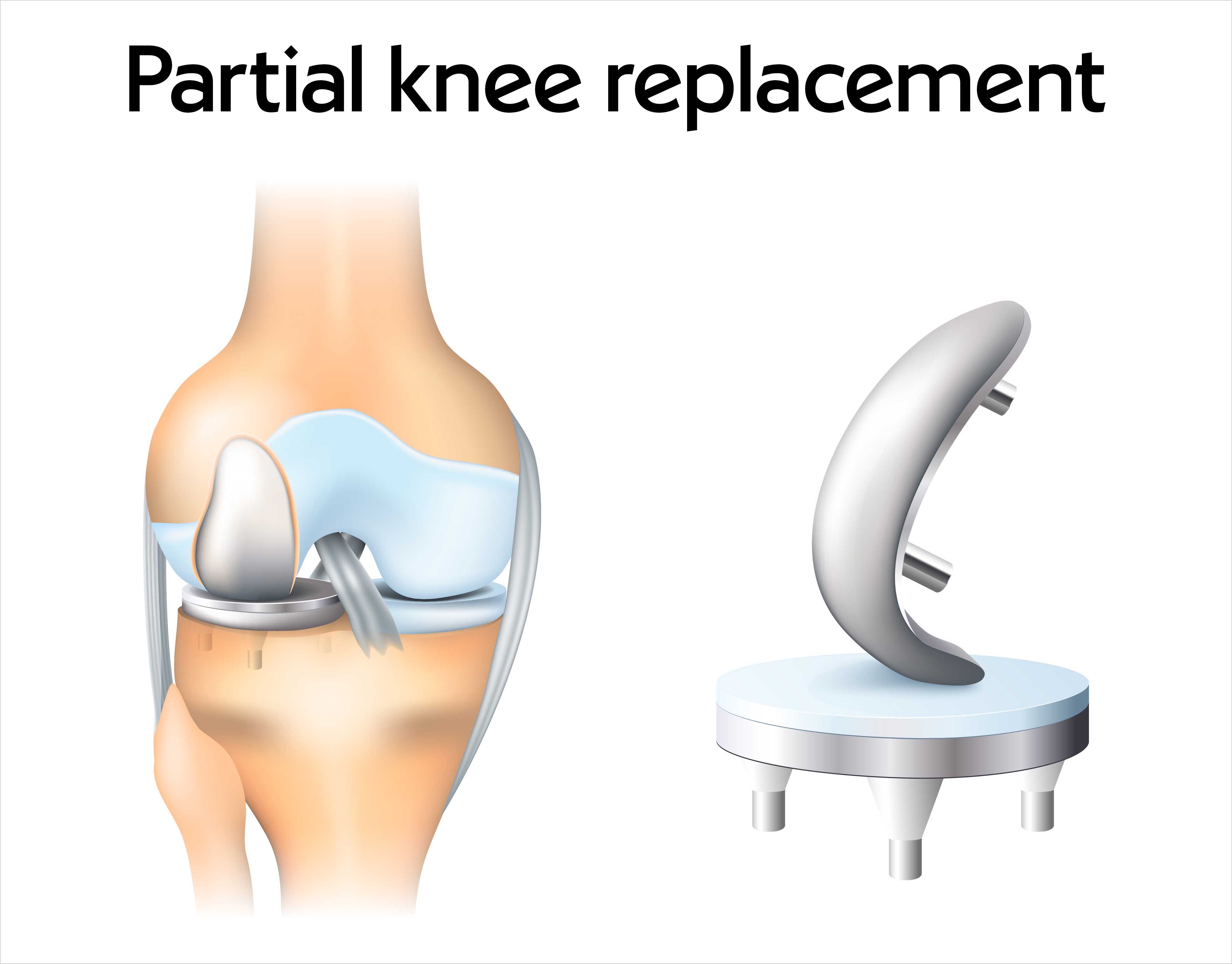
- Once you’re suitably anaesthetised, your surgeon will make an incision (cut) in the front of your knee to access the joint.
- They will move the kneecap so they can examine all three compartments of your knee to confirm that damage is limited to one compartment (medial, lateral or patellofemoral).
- They’ll then use special tools to cut away the damaged parts of bone and cartilage before fitting the artificial replacements over the ends to create the new joint.
- The kneecap will be put back in place, and the incision closed using either sutures or staples.
- It’ll be dressed in a bandage, and you’ll be taken to the recovery room where you will wait to come around from the anaesthetic or sedation.
Robotic-assisted partial knee replacement
Robotic-assisted partial knee replacement uses robotic technology to help your surgeon plan and position an implant more accurately. This method can lead to faster recovery, shorter hospital stays, and better results for many patients.
Find out more about robotic-assisted partial knee replacement
Is partial knee replacement surgery painful?
Yes, but this pain is fully controlled by medications. The actual surgery shouldn’t be painful as you’ll have anaesthetic. However, it’s normal to be in some discomfort after your procedure, and you’ll be prescribed suitable pain relief to take during this time.
How long does partial knee replacement surgery take?
A partial knee replacement surgery can usually be performed in between one and two hours depending on the surgeon, but may take less. It’s less invasive and so often quicker than a total knee replacement.
How soon can I go home after partial knee replacement surgery?
This varies between patients. Some people may be able to go home the same day as their surgery, while others may be kept in hospital for a day or two so that they can be monitored during the earliest stages of their recovery.
How long does it take to recover after partial knee replacement surgery?
Recovery after a partial knee replacement can be broken down into three stages.
Early recovery
In the early stages of your recovery, you’ll need to balance resting your knee joint with physiotherapy exercises. You’ll probably need a reasonable amount of pain relief and to use crutches so you don’t put your full weight on your knee.
Weeks two to six
If you follow your physical therapy exercises, you should be able to start walking without crutches during this stage of your recovery. You will need to avoid any high-impact exercise, but activities like cycling and swimming may be possible if your consultant allows it. You should also be able to return to work during this time, provided your role is mostly desk-based. You should also be able to start reducing how much pain medication you’re taking.
Long-term recovery
Beyond the first few months, you should notice increased improvement in the strength and mobility of your knee joint. Reliance on pain medication will continue to decrease and you may be able to start getting back to higher-impact exercise.
It’s important to note that these recovery rates are estimates, and exactly how fast you get back to normal will depend on your own circumstances. Always follow the guidance of your consultant and Nuffield Health Leeds Hospital medical team.
Does recovery time differ between partial and total knee replacement?
Yes. A total knee replacement is a larger and more invasive procedure, and recovery times reflect this.
How long can pain last after a partial knee replacement?
Everyone is different, and so the amount of time that pain lasts can vary. Typically, most people find that they take pain medication for around six to eight weeks, although the type of pain relief can vary from prescription-only to over-the-counter. Following the recovery guidance of your medical team should help ensure that your pain is manageable, and you can come off medications as quickly as possible.
When can I take a shower or bath after partial knee replacement?
You should be able to take a shower within 24-28 hours of your surgery, although you’ll be advised to keep your dressing dry. However, you shouldn’t soak your leg until the wound is fully healed, which could take between 6 and 8 weeks.
What should I avoid after partial knee replacement surgery?
Your consultant and medical team will give you strict instructions on things that you should avoid in the days and weeks after your surgery. There is an extensive list of recommendations, and these include but aren’t limited to:
- Sitting with your legs crossed
- Sitting for long periods
- Sitting in low or very soft chairs
- Soaking your incision
- Driving until you’ve been permitted to do so (usually 3 to 6 weeks after surgery)
- Heavy lifting
- High-impact exercise
- Twisting or turning the knee joint
- Kneeling
- Smoking, as this can increase your risk of post-operative complications and slow down your recovery.
How long will I need off work after a partial knee replacement?
It depends on the type of job that you do. If you have a sedentary job, you may be able to return to work quite quickly, such as within the first couple of weeks. However, if you have a role that involves long periods of time on your feet, heavy lifting or physical exertion, it could be several months before you can go back to work fully.
What are the risks and complications of partial knee replacement?
A partial knee replacement is a fairly safe and straightforward procedure, but as with any surgery, there are risks and complications to be aware of. These include, but aren’t limited to:
- Infection
- Damage to nerves or other tissues
- Bleeding and blood clots.
What is the success rate of partial knee replacement surgery?
Partial knee replacement surgery is largely very successful. Exact success rates vary, but it is estimated that over 80% of replacements last 10 years or more.
Can a partial knee replacement come loose over time?
Yes, it is possible for a partial knee replacement to come loose over time. However, it’s not common. In the unlikely event it does happen, it is usually a result of further degeneration of the knee joint, normally due to wear and tear or infection. Excessive stress on the joint from carrying too much weight or regular high-impact exercise can also accelerate the rate at which the joint breaks down, increasing the risk of the implant loosening.
How much does a partial knee replacement cost at Nuffield Health Leeds Hospital?
For pricing information, please contact out healthcare team on 0113 3227251. Our team can provide more information about the treatment and guide you through the next steps.
FAQs
-
Can a partial knee replacement help me avoid a total knee replacement?
If you only have osteoarthritis in one compartment of your knee, a partial knee replacement could help you to delay or even avoid a total knee replacement. However, there is no guarantee.
-
How long does a partial knee replacement typically last?
The life of a partial knee replacement is typically between 10 to 15 years. However, there are a number of factors that can affect exactly how long your replacement will last, including:
- whether your osteoarthritis gets worse
- how old you are
- how much weight you put through your knee joint (for example if you were to gain a lot of weight)
- how much physical activity you do.
-
How big is the scar from partial knee replacement?
The scar from a partial knee replacement is usually quite a bit shorter than a full knee replacement, with most measuring between four and six inches long.
-
What are the best sleeping positions after partial knee replacement?
The best position to sleep in after any sort of knee replacement surgery is flat on your back with your leg straight and slightly elevated. This will help to counteract swelling, ensure proper blood flow to the area (which is important for healing) and reduce the risk of stiffness.
-
How soon can you fly after a partial knee replacement?
In most cases, you’ll be recommended to wait at least six weeks before you fly following a partial knee replacement. This is to help reduce your risk of developing a complication known as deep vein thrombosis (DVT). However, you should always follow the guidance provided by your consultant.
-
Can you run after a partial knee replacement?
Yes, you will be able to run after a partial knee replacement, but not right away. You must follow the recovery guidance provided by your medical team, including your physical therapy exercises, as these will be crucial for building strength and mobility in the joint.
Many people can return to high-impact exercise in less than 6 months after partial knee replacement surgery, but always follow the advice of your consultant (surgeon) and supporting medical team.
Partial knee replacement surgery consultants at Leeds Hospital
-
Mr Joseph Aderinto Good availability
-
Mr David Duffy Good availability
-
Mr Richard Grogan Good availability
-
Mr James Hahnel Good availability
-
Mr Neil Hunt Good availability
-
Mr Sam Jain
-
Mr Chris Lewis
-
Professor Nick London Good availability
-
Mr Jeya Palan Good availability
-
Mr Ram Venkatesh Good availability
-
Mr Veysi Veysi Good availability
-
Mr George Whitwell
2 Leighton Street, Leeds, LS1 3EB
All self paying and insured patients and their guests can park of free of charge in our underground car park. Patients are also entitled to a 30% discount on parking at Q-Park, The Light, which must be pre-booked prior to arrival. Book your space and use promotional code NUFFLDS by following this link: https://www.q-park.co.uk/en-gb/cities/leeds/the-light/
Ways to pay
Nuffield Health promise
Our prices are all-inclusive. We will equal any comparable price. There are no time limits on your aftercare.
Paying for yourself
There are no hidden costs in our treatment prices. The price you see is the price you pay.
Find out morePersonal medical loan
Spread the cost of your treatment with a 10, 12 or 24 month 0% personal medical loan.
Find out moreMedical insurance
We work with you and your insurance provider to get you the treatment you need quickly.
Find out more