
Knee arthroscopy
- Overview
Or call us on
Reviewed on Monday 24 November 2025 by Mr Jaison Patel, Consultant Trauma and Orthopaedic Knee Surgeon
Knee arthroscopy, also known as keyhole knee surgery, allows your surgeon to see inside your knee joint to diagnose and treat problems inside the knee.
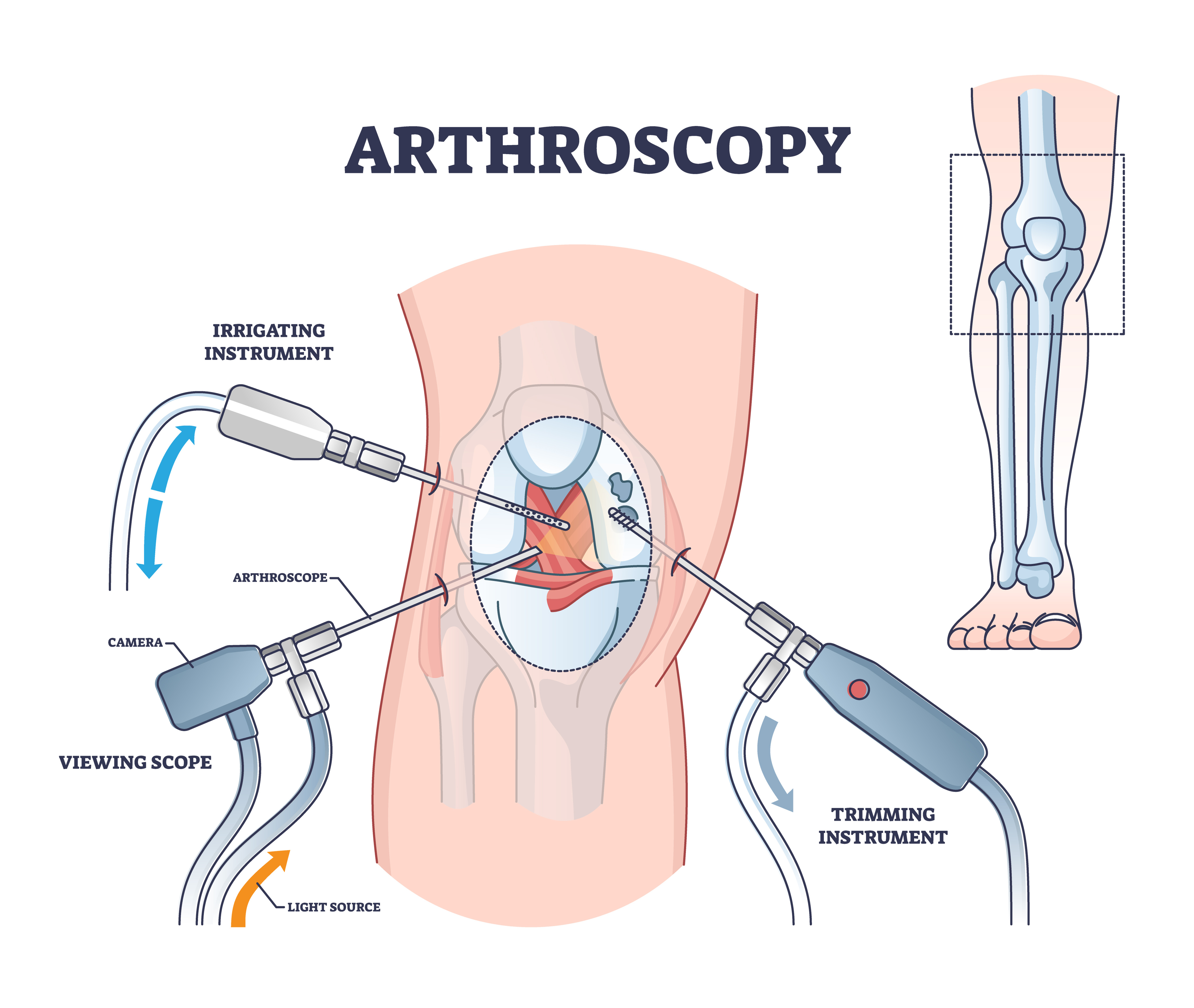
What is knee arthroscopy?
It’s a minimally invasive operation that involves inserting a small camera and specialised instruments into a tiny incisions (cuts) in your skin to examine the knee joint.
It can be used to diagnose and treat knee problems such as:
- Ligament damage
- Torn or damaged cartilage
- Misaligned kneecaps
- Meniscus tears
- Arthritis.
What treatments can be performed with knee arthroscopy?
A knee arthroscopy can also be used to treat some of the above conditions, without making a larger cut. Here are some example treatments:
- ACL repair or reconstruction – if you’ve torn your anterior cruciate ligament (ACL), this procedure stitches the damaged ligament back together and anchors this into the thigh or shin bones (repair) or creates a new ligament which is fixed into the thigh and shin bone (reconstruction)
- PLC reconstruction – for posterior cruciate ligament (PCL) tears, this operation creates a new ligament which replaces the injured ligament
- Partial meniscectomy – the damaged or torn part of the meniscus is removed, leaving as much healthy cartilage as possible
- Meniscal repair – the torn edges of the meniscus are stitched back together
- Chondroplasty – this involves removing damaged cartilage in a joint to reduce friction and pain
- Microfracture surgery – small holes are created in the exposed bony surfaces to generate a healing response, which promotes the growth of new tissue
- Cartilage grafting/transplantation – healthy cartilage is harvested from another part of the knee (autograft) or from a donor (allograft) and transplanted to the damaged area
- Patella stabilisation – if your kneecap moves out of the groove at the end of your thighbone, this surgery can reposition it
- Synovectomy – if you have synovitis where the lining of the knee joint is inflamed due to rheumatoid arthritis or infection, this surgery removes the inflamed tissue.
Knee arthroscopy can also be used to remove fragments of bone or cartilage that have broken off due to injury or arthritis or to wash out an infected knee joint (septic arthritis).
Is knee arthroscopy right for me?
If you have any of the following knee symptoms, and a scan has been inconclusive, an arthroscopy can help identify the problem:
- Persistent joint pain
- Swelling
- Stiffness
- Giving way or locking.
What happens during the knee arthroscopy procedure?
A simple knee arthroscopy usually takes around 30 to 45 minutes. Different types of anaesthetic can be used, and your anaesthetist will discuss the options with you. You may also have injections of local anaesthetic to help with the pain you feel after the operation.
Preparing for a knee arthroscopy
There are a few things you can do in the lead up to the procedure to make sure everything goes as smoothly as possible:
- Let your doctor know about any medication you take and follow their advice
- If you smoke, stop smoking several weeks before the operation
- Try to maintain a healthy weight
- Exercise regularly
- Don’t shave or wax your knee in the week beforehand
- Try to have a bath or shower either the day before or on the day of the operation
- Don’t eat or drink for 6 to 12 hours before the surgery
- If you are diabetic, keep your blood sugar levels under control
- Keep warm around the time of the procedure.
During the procedure
This is the general process for a diagnostic knee arthroscopy, but it will vary depending on what they find.
- Your surgeon will make a few small cuts in your knee (usually two)
- They’ll pump saline (sterile salt water) inside the joint through the cuts to make it easier to see, before inserting a tiny camera and examining the joint
- Depending on what they find, they’ll remove any loose material caused by wear of the joint and repair any damage to cartilage, join surfaces and ligaments – usually without making a larger cut
- If you’ve torn your ACL, you may need a reconstruction procedure, which is slightly larger operation but still performed through via knee arthroscopy
- Finally, they’ll drain the saline and close your skin with stitches or sticky strips.
After the procedure
The surgeon will wrap your knee in a bandage, which you should leave on for 2 to 3 days.
You’ll be taken to the recovery room where you’ll wake up from the anaesthetic. Your wounds, blood pressure and pulse will be checked carefully.
Recovery from knee arthroscopy
Your knee will be swollen and sore for the first week, but most people recover fairly quickly and return to normal activities within 2 to 3 weeks after a simple procedure. This can be longer depending on the type of procedure you have.
Short-term recovery
Once you’ve recovered from the anaesthetic, the healthcare team will help you stand up. They’ll tell you how much weight you can put on your leg, and whether you need crutches.
If you’re allowed to go home the same day, for the first 24 hours:
- You’ll need someone to take you home and stay with you overnight
- If you’ve had general anaesthetic, you shouldn’t sign legal documents or drink alcohol
- Don’t drive, operate machinery, or do any potentially dangerous activities (like cooking) until you’ve fully recovered feeling, movement and co-ordination.
Managing your recovery at home
There are a few things you can do to aid your recovery. Although the risk of a blood clot is minimal, make sure you follow the healthcare team’s advice carefully, and call them if you’re worried about anything.
- Wear compression stockings: For around 2 to 6 weeks after surgery to help avoid a blood clot
- Keep your wound dry: For at least 4 to 5 days and use a waterproof dressing when you have a bath or shower
- Avoid submerging the knee in baths or pools: Wait until the incisions are fully healed (usually around 2 to 3 weeks) before you do this.
- Elevate your leg and apply ice packs: Do this regularly or as advised by your care team to manage swelling, as well as improve your comfort and your ability to walk.
- Do some gentle exercises: The physiotherapist will show you some movements to prevent stiffness, maintain range of motion and improve muscle strength
- Stay active: Walking may be uncomfortable at first, so take any painkillers we’ve prescribed you for some relief. Short trips around the house are fine, but you should limit longer walks for the first 2 to 4 weeks if you’ve had a minor procedure.
- Don’t rush your recovery: Progress the intensity and duration of exercise gradually – doing too much too soon can aggravate your healing and potentially set back your healing.
- Don’t push through the pain While some discomfort is normal, sharp or increasing pain is a signal to slow down and rest
- Avoid limping: Try to walk with as normal a gait as possible, even if you need crutches to achieve it. Limping can lead to compensatory movements and pain in other joints.
Follow-up appointments
The healthcare team will let you know if you need to come back to have any stitches removed or dressings changed.
What are the benefits of knee arthroscopy?
As a method of surgery, keyhole knee surgery offers several benefits, compared to traditional ‘open’ knee surgery.
- Minimally invasive: Only small cuts are required, resulting in less damage to surrounding tissues
- Lower risk of complications:The risk of bleeding and infection is lower due to smaller incisions
- Less pain and swelling:Again, as your surgeon will only make small cuts, you're likely to have less pain and discomfort afterwards
- Quick and accurate diagnosis and treatment:The arthroscope provides a clear view of the inside of the knee and can be used to both diagnose and treat the problem at the same time
- Shorter recovery time: Most people recover quickly and canreturn to their normal activities within 2 to 3 weeks.
The actual benefits of certain arthroscopic knee treatments may be more pronounced for specific conditions and more limited for others, such as advanced osteoarthritis.
How long do the benefits of knee arthroscopy last?
This varies significantly depending on the condition being treated, the extent of the damage, individual patient factors (age, activity level, overall health), and how well you follow your rehab programme.
It is particularly effective for mechanical issues like meniscal tears requiring repair and ACL reconstruction. For degenerative conditions, particularly widespread cartilage loss, the benefits may be more limited and temporary.
It's essential to have a realistic discussion with your orthopaedic surgeon about the expected outcomes and potential longevity of the benefits for your specific condition.
ACL/PCL reconstruction
Typically highly successful with good long-term results (10 to 20 years), however there is still a risk of re-tearing the reconstructed ligament, especially in young, active individuals.
Also, despite successful reconstruction, some patients may still develop osteoarthritis in the long term, as the initial injury and subsequent surgery can contribute to degenerative changes in the joint.
Partial meniscectomy
Many patients experience significant pain relief and improved function in the short term.
However, some studies suggest a significant percentage of patients may experience progression of osteoarthritis or even require repeat surgery (including total knee replacement) within 10 to 20 years, especially if there was pre-existing osteoarthritis.
Meniscal repair
This has better long-term potential if the repair is successful as it aims to preserve the natural meniscus. However meniscal repairs have a higher failure rate compare to partial meniscectomies, especially in older patients or complex tears.
Recovery is often longer and more restrictive than partial meniscectomy to allow the repair to heal.
Chondroplasty
This provides symptomatic relief but does not restore the original hyaline cartilage. Its benefits are often considered temporary, especially for more extensive or degenerative cartilage loss.
Studies have shown that a significant proportion of patients undergoing chondroplasty may require subsequent knee replacement (knee arthroplasty) within 1 to 5 years.
Microfracture
Microfracture stimulates the growth of fibrocartilage, which is a less durable and biomechanically inferior tissue compared to the original hyaline cartilage.
While it can provide relief for smaller defects, the fibrocartilage may break down over time, leading to a return of symptoms. Its long-term efficacy is generally considered less robust than procedures that restore hyaline cartilage.
Cartilage grafting/transplantation
Procedures that involve transplanting healthy cartilage (e.g. OATS, autologous chondrocyte implantation) aim to restore hyaline cartilage and therefore have the potential for more durable, long-term benefits.
However, these procedures are more complex, have longer recovery times and their long-term success rates are still under ongoing research and vary depending on the specific technique and patient factors.
Removal of loose bodies, synovitis etc
For conditions like removal of bone fragments/cartilage or inflamed synovium, arthroscopic removal typically provides immediate relief from symptoms.
The long-term benefit depends on the underlying cause of the loose bodies or inflammation. If the underlying condition (e.g. early osteoarthritis causing cartilage flakes) progresses, new symptoms may arise.
What are the risks of knee arthroscopy?
Possible side effects following knee arthroscopy surgery
- Pain: This is a common side effect of arthroscopic surgery. Your surgeon may inject painkillers into your knee to help reduce the pain. The healthcare team will also give you medication to control the pain.
- Swelling: This may increase for the first few days before gradually subsiding over several weeks, sometimes up to 12 weeks. It’s crucial to elevate the leg and apply ice packs to manage swelling.
- Scarring: Although arthroscopy scars are usually small and neat. You may also have some tenderness, redness and irritation around your incisions.
- Bruising: This can occur around your knee and may extend down your leg.
- Stiffness: This is due to the swelling, pain and the formation of scar tissue. Physiotherapy exercises are essential to regain full range of motion and prevent persistent stiffness.
- Numbness: Because of the minor nerve irritation, you may have small patches of temporary numbness around the incision sites, but significant nerve damage is rare.
Specific complications of knee arthroscopy
- Damage in the nerves around your knee, leading to weakness, numbness or pain in your leg or foot
- Infection in your knee joint
- Severe pain, stiffness and loss of use of your knee (complex regional pain syndrome).
General complications of knee arthroscopy
- Bleeding during or after the procedure
- Infection of the surgical wound
- Allergic reaction to the equipment, materials or medication
- Venous thromboembolism (VTE) – blood clot in your leg (deep vein thrombosis)
- Difficulty passing urine
- Chest infection.
Alternatives to knee arthroscopy
Physiotherapy and anti-inflammatory painkillers such as ibuprofen can sometimes prevent or delay the need for an arthroscopy.
Problems inside your knee can often be diagnosed using an X-ray or MRI scan, but you may then need an arthroscopy to treat the problem.
How much does a knee arthroscopy cost?
Click here and select your local Nuffield Health hospital to find the guide prices for knee arthroscopy.
Please note that the guide price stated is an approximate cost of treatment only. You will be given a fixed all-inclusive price for treatment following your initial consultation with a consultant.
If there isn't a guide price showing for knee arthroscopy, get in touch with your local Nuffield Health hospital.
FAQs
-
How soon can I walk after knee arthroscopy surgery?This will vary depending on which specific procedure you have, the extent of your injury, and individual factors. However, for most routine procedures, you can start to put weight on your operated leg quite soon after surgery. The aim is to achieve a normal gait without limping.
For diagnostic arthroscopy or minor procedures (simple meniscectomy, loose body removal and chondroplasty) you can begin walking after a few hours with crutches or a cane. You can use progressive weight bearing, meaning you can gradually put as much weight on the leg as is comfortable.
For more complex procedures (meniscal repair, microfracture, ligament reconstruction), it’s crucial to restrict weight bearing for healing:
- Meniscal repair: You may be advised to be partial weight-bearing (PWB – only putting a small amount of weight on the foot, often with crutches) or even non-weight-bearing (NWB – no weight on the operated leg at all) for 4 to 6 weeks. A knee brace may also be prescribed to limit range of motion and protect the repair while you walk.
- Microfracture: Similar to meniscal repair, patients often need to be partial or non-weight-bearing with crutches for around 6 weeks to protect the newly forming cartilage.
- ACL reconstruction: Patients typically use crutches for 2 to 6 weeks after ACL reconstruction. While immediate weight-bearing is recommended in most cases, full, comfortable weight-bearing and walking without a limp usually takes a few weeks. A brace is sometimes used to protect the new graft.
Always follow your medical team’s instructions closely as they’ll provide specific rehabilitation instructions tailored to your exact surgery and individual needs. -
Will I need crutches after knee arthroscopy?Many patients are advised to use crutches for the first few days to a week to reduce weight-bearing on the operated knee. Crutches are often weaned off once you can walk normally without significant pain or limping.
If you have a more complex arthroscopic procedure you may need to use crutches for longer. For example, if you have a meniscus repair, you’ll likely need to be non-weight-bearing (NWB) or partial weight-bearing (PWB) with crutches for a longer period (around 4 to 6 weeks), and potentially wear a brace.
For less complex procedures, you may be able to walk without crutches within a few days, or even immediately after the operation, if your surgeon advises it and you feel comfortable and confident. Rushing off crutches too soon can aggravate the knee and lead to compensatory walking patterns. Your physiotherapist or healthcare team will guide you on when to reduce and stop using crutches. -
Do I need to wear compression stockings after knee arthroscopy?Yes, it’s often recommended to wear compression stockings for around 2 to 6 weeks after knee arthroscopy. Your healthcare team will advise on the correct size, compression level and how long to wear them.
Any surgery, especially those involving the lower limbs, carries a risk of developing blood clots (DVT) in the legs. This is due to reduced mobility, changes in blood flow, and the body's clotting response to surgery. If a clot breaks away and travels to the lungs (pulmonary embolism or PE), it can be life-threatening.
Compression stockings apply graduated pressure, meaning they are tightest at the ankle and gradually less tight up the leg. This helps to promote blood flow back to the heart, preventing blood from pooling in the lower legs and reducing the risk of clot formation. This also enhances overall blood circulation, contributing to faster healing.
Compression can further help to manage any swelling by gently squeezing the tissues, which aids in fluid drainage and reduces discomfort. Reduced swelling can also help with pain management and facilitate earlier mobility and rehabilitation. -
How soon can I exercise after knee arthroscopy?This depends heavily on the specific procedure performed and your body’s healing response. But you can typically begin very gentle exercises almost immediately, often on the same day or the day after surgery. These exercises are crucial for reducing swelling, preventing stiffness, improving circulation and maintaining muscle strength.
As pain and swelling subside (1 to 6 weeks), your physiotherapist will guide you through a gradual progression of exercises. The focus will be on restoring full range of motion, strengthening and balance. Light cycling or swimming can be introduced once wounds are closed and your surgeon approves.
For non-complex arthroscopies, you can return to gentle sports within 3 to 6 weeks if you’ve got back to full strength, endurance and agility, and you are pain free. For more vigorous sports, it may take several months, and a check with your surgeon or physio before getting into these.
Always listen to your body to avoid overdoing it. If you’re experiencing any pain, swelling or you feel unstable, you should slow down and consult your surgeon or physio. -
How soon can I drive after knee arthroscopy?The timeline for returning to driving after knee arthroscopy varies significantly, and it's crucial to prioritise safety.
If your right knee was operated on, your return to driving will generally take longer, regardless of car type. You need to be able to safely and quickly operate the accelerator and brake pedals, especially for an emergency stop. This requires adequate strength, range of motion and reaction time, as well as being free from pain that could affect your ability to react.
If your left knee was operated on and you drive a manual car, you will also need sufficient strength and range of motion to operate the clutch pedal without pain or hesitation.
For right knee (automatic or manual car) or left knee (manual car) operations you should wait around 1 to 4 weeks if you have a more complex knee arthroscopy, but you may be able to drive after 3 to 4 days if you have a simpler knee arthroscopy.
If your left knee was operated on and you drive an automatic car (where only the right foot operates pedals), you may be able to drive much sooner, potentially within 48 hours to 1 week after surgery, once the immediate effects of anaesthesia wear off and you are not taking sedating pain medications. Make sure you’re confident you can control your vehicle and always check with your insurance company and your doctor. -
Can I shower independently after knee arthroscopy surgery?This depends on the type of dressing you have, your pain level and your overall mobility and balance.
The most critical factor is protecting your incisions from excessive moisture to prevent infection. Many surgeons advise keeping the dressing clean and dry for the first 24 to 72 hours (1 to 3 days) after surgery.
Some surgeons use waterproof dressings that allow you to shower earlier, often within 48 hours. If you have these, they are designed to get wet, but you should still avoid scrubbing the incision area directly.
You may have small tape strips (steri strips) directly over your incisions. These are generally left on and can get wet in the shower after the initial dry period, as they often fall off on their own within 1 to 2 weeks. Do not pull them off.
Avoid baths, hot tubs, or swimming pools until your incisions are completely healed and your surgeon gives you the go-ahead, which is typically 7 to 14 days, or even up to 3 to 4 weeks after surgery, to minimize infection risk. -
How long will I be off work following knee arthroscopy surgery?It depends on the type of procedure and the type of work you do. Simple procedures (simple meniscectomy, loose body removal and chondroplasty) have shorter recovery times compared to complex procedures (meniscal repair, microfracture, ligament reconstruction).
If your job involves mostly sitting, with minimal walking, standing, or lifting, you might be able to return to work relatively quickly. This may be as little as 2 to 7 days for office workers, especially if you can work from home initially or have a short, easy commute.
If your job involves some walking, light lifting, or standing for periods, you’ll need more time. This could be anywhere from 2 to 4 weeks.
If your job requires heavy lifting, prolonged standing, extensive walking, climbing stairs or ladders, or repetitive squatting/kneeling, you will need a much longer period off. This can range from 4 to 12 weeks, or even several months for very demanding roles or complex repairs. -
How soon can I fly after knee arthroscopy?This can vary significantly depending on your surgery and your surgeon’s recommendations. It’s important to make sure your body has had time to heal before you fly.
Generally, you should be able to fly on a short flight (up to 4 hours) between 2 days and 2 weeks after simple arthroscopic surgery. For long-haul flights (over 6 hours) you should wait 6 weeks to 3 months after knee arthroscopy. If you have a meniscus repair or ACL reconstruction, you should wait 3 to 4 months.
Because you tend to be inactive for a long time during flights, you’re at a higher risk of a blood clot (deep vein thrombosis or DVT), which can lead to pulmonary embolism (PE) – a serious and potentially life-threatening condition. After surgery, you’re also at a higher risk of DVT and PE because your body’s blood clotting system is elevated as a protective mechanism.
To avoid any complications, make sure you walk around during the flight when it’s safe to do so, do some gentle foot and ankles stretches and stay well hydrated. -
How long will I need off work?The time you will need to take off work after surgery will depend on your type of work. Usually you’ll be able to return to work after about 1 to 2 weeks if you work from home or have an office job. If you have a physical job that requires lifting or strenuous activity, you may need 3 to 4 weeks off work.
However, this will all depend on your healing process as well. Your surgeon and the team at Nuffield Health will when is best to return to work based on how well you are progressing with your recovery. -
How soon can I swim after knee arthroscopy?This depends on your own healing progress and the specific procedure you had. Don’t immerse your knee in water until advised by your surgeon and follow instructions from your physiotherapist before starting an exercise regime.
The most crucial factor is that your surgical incisions must be completely healed and free of scabs to prevent infection. This typically takes 1 to 2 weeks after surgery, but if you have a more complex procedure or slower healing, it might be 3 to 6 weeks before swimming is recommended.
You should also make sure you have a good range of motion in your knee before attempting swimming. While some swelling and discomfort are normal, excessive swelling or pain indicates you might be pushing too hard, so listen to your body.
Start with straight leg kicking (breaststroke can twist the knee unnecessarily), and gradually increase the intensity and duration of your workouts.
Hydrotherapy is highly recommended during recovery because the water reduces stress on the knee joint, while providing resistance for strengthening. This can be helpful in the early stages when weight-bearing is still painful.
Ways to pay
Nuffield Health promise
Our prices are all-inclusive. We will equal any comparable price. There are no time limits on your aftercare.
Paying for yourself
There are no hidden costs in our treatment prices. The price you see is the price you pay.
Find out morePersonal medical loan
Spread the cost of your treatment with a 10, 12 or 24 month 0% personal medical loan.
Find out moreMedical insurance
We work with you and your insurance provider to get you the treatment you need quickly
Find out more