
Robotic-assisted hip replacement
- Overview
Reviewed on Tuesday 2 December 2025 by Mr Arthur Stephen, Consultant Orthopaedic Surgeon at Nuffield Health Derby Hospital and Chief Medical Officer for Nuffield Health.
Robotic-assisted total hip replacement is a surgical technique where a surgeon uses a robotic device to help implant an artificial joint, also known as prosthesis.
What is robotic-assisted hip replacement?
Robotic-assisted total hip replacement is a type of hip replacement surgery that uses advanced computer technology and a robotic arm to help your surgeon plan and perform the operation. The surgeon will still perform the incision and make all of the soft tissue cuts, and will be in total control of the surgical procedure.
Your consultant orthopaedic surgeon performs the surgery, but the robot acts like a “navigation tool” that helps your surgeon to:
- Create a 3D plan of your unique hip joint.
- Position your hip implant with great accuracy. This can be especially useful if you have unusual anatomy or have been involved in a previous trauma.
This will help improve the position of your new prosthesis (hip replacement) for maximum functional ability.
Am I a suitable candidate for robotic-assisted hip replacement?
Your consultant surgeon will review your overall condition, bone quality and specific anatomy (often using tests and imaging such as a CT scan) to determine if you are suitable for robotic-assisted hip replacement.
If you are not suitable, there are alternative treatments, such as conventional hip replacement and hip resurfacing.
How robotic technology enhances total hip replacement
Before your surgery, additional imaging is taken to build a 3D model of your hip. Your surgeon will use this information to plan your surgery, including:
- The best size and type of implant to use.
- The exact position and angle of the implant.
- How much bone needs to be removed.
During the operation, the robotic arm helps your surgeon follow this plan very closely. The robotic system is similar to a car SatNav, it shows the surgeon, in real-time, exactly what position in the joint they are in. It can also give real-time feedback, guiding your surgeon within a “safe zone” and helping avoid incorrect bone cuts. This precise planning is particularly useful if:
- Your hip is complex.
- You’ve had previous surgery, trauma or a congenital deformity.
- There is significant deformity or bone loss.
At Nuffield Health, we use Stryker’s Mako SmartRobotics™ system for robotic-assisted hip replacements. The Mako system has a significant track record with over 1.5 million procedures¹ performed globally since its introduction. We have utilised the Mako system since 2017, and some of our hospitals have completed over 1,000 Mako robot-assisted surgeries.
What’s the difference between conventional and robotic-assisted hip replacement?
The actual prosthesis used is the same as in a conventional hip replacement. Robotic-assisted hip replacement builds on conventional hip replacement techniques rather than replacing them. Your surgeon still uses their clinical judgment and experience at every stage, but has additional tools to support decision-making.
Robotic technology can help your surgeon to:
- Plan more accurately: 3D imaging gives a detailed view of your hip joint before surgery.
- Place the implant precisely: The robotic arm can help position the implant at the planned angle and depth.
- Balance leg length and joint alignment: Better alignment improves how your hip feels and may reduce the risk of dislocation.
The aim of any hip replacement is a well-aligned, stable and comfortable joint. While this is absolutely achievable with conventional hip replacement techniques, the added accuracy of robotic technology can further enhance implant positioning, helping your surgeon tailor the operation more closely to your individual hip anatomy.
Conditions we treat with robotic-assisted hip replacement
Robotic-assisted hip replacement treats the same conditions as conventional hip replacement surgery, which cause long-term hip pain and reduced movement, such as osteoarthritis and rheumatoid arthritis. Robotic-assisted surgery can be beneficial for complex hips or those with abnormal anatomy due to conditions such as hip dysplasia and Perthes disease.
What happens during robotic-assisted hip replacement?
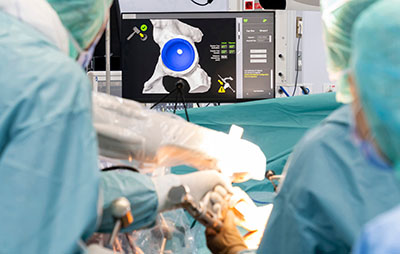
Robotic-assisted hip replacement surgery typically takes between 60 to 90 minutes. There may also be an additional 20 to 30 minutes dedicated to setting up the robotic system. This includes:
- Placing tracking pins around the hip.
- “Registering” your hip anatomy to the pre-operative 3D plan.
- Calibrating the robotic arm system.
The surgery is usually done under spinal anaesthetic to numb the lower half of your body, and you’ll also be given a sedative to relax you. Your consultant or anaesthetist will discuss your options with you.
Apart from the extra planning before surgery and a small additional amount of time in theatre, the surgery should be the same as a conventional hip replacement.
Recovery from robotic-assisted hip replacement
Recovery from robotic-assisted hip replacement is similar to recovery from conventional hip replacement.
Your surgeon and healthcare team will advise what you can and cannot do after hip replacement surgery, such as staying as active as possible, avoiding twisting your hip when standing, and doing your post-operative exercises often.
Find out more about recovery from hip replacement.
What are the risks and complications of robotic-assisted hip replacement?
Complications can occur during any surgery. Your consultant (surgeon) will talk you through these risks and answer any questions you may have.
General complications include pain, infection of the surgical wound and blood clots.
Specific complications from hip replacement (conventional and robotic-assisted surgery) may include nerve damage, fracture, leg length difference and dislocation.
Learn more about the risks and possible complications of hip replacement surgery.
FAQs
-
Is robotic-assisted hip replacement better than conventional surgery?Robotic technology enhances conventional hip replacement techniques. The robot is a tool that helps your surgeon to position your hip implant with great accuracy. This can be especially useful if you have unusual anatomy or have been involved in a previous trauma.
-
How long has the Mako robotic system been available?The Mako SmartRobotics™ system was first used for partial knee replacements around 2006–2007. It was then adapted for total hip replacement a few years later and has been widely used since the 2010s.
-
Does the robotic arm perform the surgery?No, the surgeon performs the surgery. The Mako SmartRobotics™ system is a tool the surgeon controls to guide the instruments and keep movements within the safe, planned area. The surgeon is always in control.
-
Will I have less pain after robotic-assisted hip replacement?Patients who've had robotic-assisted joint replacement surgery have reported to have lower pain scores compared with conventional joint replacements. However, it is important to remember that every patient heals differently and recovery can vary from person to person.
-
How long will my hip replacement implant last?Hip replacements can last a long time - around 15 to 20 years, depending on your age, activity level, general health and the type of implant you have. However, better positioning of the prosthesis from robotic assistance may lead to less uneven wear and potentially increase the implants lifespan.
-
Is robotic-assisted surgery covered by private health insurance?Yes, robotic-assisted hip replacement surgery is covered by most private health insurers. We do recommend you speak directly with your insurer to confirm coverage.
-
What is the difference between robotic and computer-assisted surgery?Computer-assisted surgery (CAS) uses tracking technology and screens to show the surgeon where the instruments and implants are in real time, but the surgeon moves everything by hand.
Robotic-assisted surgery takes this a step further - the robot arm shows the surgeon, in real-time, exactly what position in the joint they are in. It can also give real-time feedback, guiding your surgeon within a “safe zone” and helping avoid incorrect bone cuts.
Sources
1 - https://www.stryker.com/us/en/about/news/2025/stryker-showcases-next-generation-of-mako-smartrobotic...
Ways to pay
Nuffield Health promise
Our prices are all-inclusive. We will equal any comparable price. There are no time limits on your aftercare.
Paying for yourself
There are no hidden costs in our treatment prices. The price you see is the price you pay.
Find out morePersonal medical loan
Spread the cost of your treatment with a 10, 12 or 24 month 0% personal medical loan.
Find out moreMedical insurance
We work with you and your insurance provider to get you the treatment you need quickly.
Find out more