
Arthrosamid® injections at Bournemouth Hospital
- Overview
Arthrosamid® injections is a non-surgical treatment for people with knee osteoarthritis - helping to reduce pain, ease stiffness, and improve mobility. At Nuffield Health Bournemouth Hospital, our experienced specialists can assess your symptoms and help determine whether Arthrosamid® is the right treatment for you.
What is Arthrosamid®?
Arthrosamid® is a commonly used treatment to relieve some symptoms of mild to moderate knee osteoarthritis.
Arthrosamid® is an injectable solution that is 97.5% water and 2.5% gel1. The gel is Polyacrylamide, and it’s this part of the solution that creates a layer of cushioning inside the knee joint, reducing the pain and inflammation that is linked to knee osteoarthritis.
It’s important to note that Arthrosamid® is not a treatment for inflammatory arthritis, also known as rheumatoid arthritis. Arthrosamid® is less effective for those with severe arthritis, when a knee replacement is typically recommended as providing more reliable symptom relief and mobility improvements.
How does an Arthrosamid® injection work?
Arthrosamid® injections work by introducing a hydrogel that permanently alters the lining of the knee joint cavity between your thigh bone (femur), shin bone (tibia) and kneecap (patella). This gel improves the flexibility of the joint lining in a way that reduces stiffness (friction) and inflammation that occurs from movement, and this, in turn, reduces pain.
The injections are performed by your orthopaedic consultant and are done under local anaesthetic, meaning you shouldn’t feel any discomfort during the procedure.
Why choose Nuffield Health Bournemouth Hospital for your Arthrosamid® injections?
Nuffield Health Bournemouth Hospital is a trusted choice for Arthrosamid® treatment, offering expert-led care in a modern private healthcare setting. Our experienced specialists assess each patient individually, ensuring treatment is tailored to your symptoms, lifestyle, and long-term goals for managing knee osteoarthritis.
With a strong reputation for high-quality orthopaedic care, advanced clinical facilities, and a patient-centred approach, we are committed to delivering the highest standards of treatment and support. Conveniently located near Bournemouth town centre, our hospital provides a comfortable environment where you can access specialist care with confidence, from your initial consultation through to follow-up and ongoing management of your knee health.
How to book a consultation at Nuffield Health Bournemouth Hospital?
Ready to find out whether Arthrosamid® treatment could help with your knee osteoarthritis symptoms? Arrange a consultation with one of our experienced specialists at Nuffield Health Bournemouth Hospital. You can book your appointment online, call our team on 01202 291866, or complete the enquiry form below.
What are the benefits of an Arthrosamid® injection?
Arthrosamid® injections provide a range of benefits for people with knee osteoarthritis, including:
- Less pain: Studies have shown that Arthrosamid® is effective in providing long-term relief from discomfort2.
- Better knee movement: People treated with Arthrosamid® often experience better movement within their knee joint, enabling them to return to their usual daily activities with fewer restrictions.
- A minimally invasive treatment: Arthrosamid® is performed under local anaesthetic and carries fewer risks and a shorter recovery period than surgery.
- Delay surgical treatments: Arthrosamid® injections can help provide relief from symptoms that enable you to delay surgical treatment options such as knee replacement surgery.
How do I know if I need an Arthrosamid® injection?
Your orthopaedic consultant will be able to advise you if you may be a good candidate for an Arthrosamid® injection.
What else is Arthrosamid® known as?
Arthrosamid® is also referred to as a hydrogel knee injection, a knee gel injection or a knee osteoarthritis injection. It’s not to be confused with steroid injections, which are a completely different treatment.
What conditions can an Arthrosamid® injection treat?
Arthrosamid® was developed and is mainly used for the treatment of knee osteoarthritis.
What is knee osteoarthritis, and what causes it?
Knee osteoarthritis is a complex inflammatory and degenerative condition which may be associated with an injury, your genetics or family history, hormonal changes, and general wear and tear. It happens when the smooth cartilage that usually covers the bones starts to break down. When this happens, the rough surfaces of the bones rub together instead, and this causes pain and can make simple day-to-day activities, such as getting up or walking around, more difficult.
Who is suitable for Arthrosamid®?
Arthrosamid® injections are usually recommended if you have mild to moderate knee osteoarthritis and if treatments such as anti-inflammatory medications and exercise aren’t effective in reducing your symptoms. You may be considered too young for knee replacement surgery, or if you want to delay it – for example, if you have an active lifestyle that you want to maintain and are keen to avoid a lengthy recovery period.
Who is not suitable for Arthrosamid®?
Arthrosamid® injections aren’t recommended for people with:
- Rheumatoid/inflammatory knee arthritis.
- Active or systemic knee infection.
- Haemophilia, or if you’re taking blood-thinning medication.
- Have had recent surgery.
Arthrosamid® is known to be less reliable and effective in those with advanced, ‘bone-on-bone’ arthritis. Knee replacement (or partial knee replacement) is typically recommended instead, as it is a more powerful and reliable treatment for advanced arthritis.
What happens during Arthrosamid® treatment at Bournemouth Hospital?
How can I prepare for an Arthrosamid® injection?
Before your injection, you’ll need to have a comprehensive consultation with a member of our team. They’ll undertake a complete review of your medical history, as well as reviewing any diagnostic tests you’ve had (blood tests, X-rays, scans) to confirm your diagnosis.
You’ll have a brief discussion around any treatments you’ve already tried, and your consultant will explain the possible risks and benefits of Arthrosamid®. If you decide to go ahead, you’ll receive a quote for the procedure from the hospital, and then you’ll have an appointment scheduled to come back for the treatment.
Before your treatment
Since Arthrosamid® usually only requires a local anaesthetic, you can usually eat or drink as normal before your treatment unless advised otherwise. You may be advised to stop taking certain medications and you should always follow the advice of your consultant.
You may also be advised to arrange for someone to drive you home so that you can rest immediately after your treatment. Wear comfortable, loose-fitting clothes that will give your consultant easy access to your knee.
Why do I need to take antibiotics before an Arthrosamid® injection?
It’s standard practice for your consultant to give you a dose of an antibiotic before your Arthrosamid® injection. This is because the treatment is a permanently implanted gel that stays in your knee joint, unlike temporary injections like steroids, which dissolve over time. As a result, antibiotics are given to minimise the risk of infection at the point of treatment.
What should I expect during an Arthrosamid® injection?
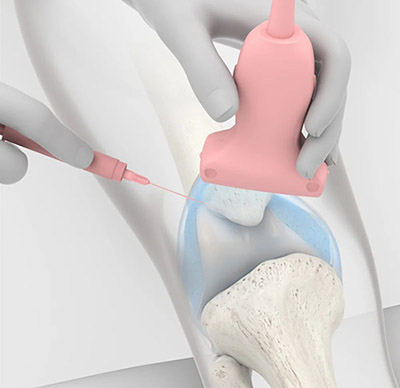
The procedure itself will usually take around 30 minutes.
You’ll be asked to sit or lie comfortably with your knee exposed. Your consultant will clean your knee with an antiseptic to ensure the area is sterile.
Next, your consultant will inject a local anaesthetic into your knee to numb the area. This will take just a few minutes to work. Then, using an ultrasound to help guide it, the needle for the injection will be inserted into the knee joint space and the Arthrosamid® injected.
Once the injection is complete, the needle will be removed, and a small dressing will be placed over the injection site to keep it clean.
Recovery from Arthrosamid® treatment
You’ll be able to go home the same day as your procedure, and you should make sure you’ve got someone to take you, so you don’t have to drive.
For the first 48 hours, you may notice some swelling, tenderness and pain around the injection site. It’s completely normal, and you can use painkillers and cooling/ice packs to help relieve your discomfort if you feel you need to. You’ll be advised to rest your knee as much as you can, and avoid long periods of standing, any strenuous exercise and heavy lifting. If you have a desk-based job, you may be able to go back to work the following day. However, you should always follow your consultant’s instructions.
After a couple of weeks, you can start to get back to your usual daily activities, including mild activity. However, you’ll still need to avoid any intense physical activity or heavy lifting.
It usually takes a few weeks to feel the benefit from an Arthrosamid® injection. It is therefore normal not to feel any benefit or change in symptoms in the immediate days after the injection.
How long do the effects of an Arthrosamid® injection last?
Clinical studies and patient reports suggest that the effects of Arthrosamid® injections can last as long as five years following treatment.
What is the success rate of an Arthrosamid® injection?
According to the manufacturer’s own research, Arthrosamid® injections have a very good success rate, with 70-80% of patients with knee osteoarthritis reporting significant, clinically meaningful pain reduction for up to five years3.
What are the risks and complications of an Arthrosamid® injection?
Arthrosamid® is generally considered to be a very safe and effective treatment. However, as with all medications, there are potential risks and side effects to be aware of. These will be explained to you by your consultant before your treatment.
Common/mild side effects include:
- Pain, swelling and redness at the injection site.
- Bruising around the injection site.
- A knee that feels heavy/full.
Rare side effects include:
- Infection at the site of the injection: If you notice the area becomes red, inflamed and hot to the touch, or there’s any visible pus, contact a member of our team or your doctor right away. If these symptoms are severe or you feel unwell, you must seek urgent medical attention.
- Allergic reaction to either the anaesthetic or any of the equipment used during the injection procedure.
- A temporary increase in the stiffness in your knee.
If you have any questions or concerns about the risks or side effects involved in Arthrosamid® injections, speak to your orthopaedic consultant.
What are the alternatives to an Arthrosamid® injection?
There are some alternatives to Arthrosamid®, and these are usually offered before this line of treatment. In addition to pain-relieving medications and physical therapy, they include:
- Steroid injections: Also known as corticosteroid injections, they provide fast-acting relief from pain and inflammation.
- Hyaluronic acid injection: Also aimed at reducing inflammation and may have a slightly longer-lasting effect than a steroid injection.
- Platelet-Rich Plasma (PRP): These injections use concentrated platelets from your own blood and have been shown to reduce inflammation and boost your body’s natural healing ability.
Arthrosamid® vs other knee injections – what’s the difference?
The main difference between Arthrosamid® and other knee injections is that it remains in the knee permanently and therefore has the potential for much longer-lasting benefit. For this reason, Arthrosamid® is typically given as a single treatment and has the potential to provide relief from knee osteoarthritis symptoms for as long as three to five years2.
In contrast, other injections often require multiple treatments, often with diminishing benefits from each subsequent injection.
How much does an Arthrosamid® injection cost at Bournemouth Hospital?
If you'd like to discuss treatment costs, please contact our team on 01202 291866. We'll be happy to provide pricing information. The hospital or your healthcare team will give you a fixed all-inclusive price for the treatment following your initial consultation.
Sources:
1 https://hcp.arthrosamid.com/the-science
2 https://arthrosamid.com/post/new-data-is-welcomed-as-the-results-of-the-much-anticipated-luna-study-...
3 https://arthrosamid.com/results
4 https://pmc.ncbi.nlm.nih.gov/articles/PMC12023473/
5 https://pmc.ncbi.nlm.nih.gov/articles/PMC10570668/
FAQS
-
Is Arthrosamid® a new injection for knee pain?
No, it’s not. Although Arthrosamid® was first introduced as a treatment for knee osteoarthritis in the UK in 2023 (following approval in Europe in 2021), the product has been in human use for various indications since 2000.
-
Can Arthrosamid® injections delay or prevent knee replacements?
Yes, some people may have Arthrosamid® injections to help delay the need for a knee replacement. The potential benefit varies according to the severity of your arthritis, and it is crucial you seek a consultation and discussion with a knee surgeon before proceeding. In more advanced osteoarthritis, Arthrosamid® is a less reliable option and a knee replacement will usually be recommended instead.
-
Can I have Arthrosamid® injections in both knees?
Yes, it is possible to have Arthrosamid® injections in both knees, even on the same day. However, you should speak to your consultant for their specific advice around this.
-
Can I have more than one Arthrosamid® injection?
You should expect some discomfort from the needle but you’ll be given a local anaesthetic ahead of your Arthrosamid® injection to minimise this discomfort.
-
How quickly will I see results after an Arthrosamid® injection?
Although some people report feeling improvement in their knee within 24 hours, maximum benefit is usually only achieved around 12 weeks post-treatment.
-
Do I need a referral for a Arthrosamid® injection?
You will need to have a consultation with an orthopaedic consultant before you can access an Arthrosamid® injection. This is to confirm your diagnosis and ensure that it is the best course of treatment for you.
-
Does private health insurance cover Arthrosamid® injections?
You will need to check with your specific private health insurance company to see if your policy will cover Arthrosamid® injections.
Arthrosamid® injections consultants at Bournemouth Hospital
67 Lansdowne Road, Bournemouth, BH1 1RW
Ways to pay
Nuffield Health promise
Our prices are all-inclusive. We will equal any comparable price. There are no time limits on your aftercare.
Paying for yourself
There are no hidden costs in our treatment prices. The price you see is the price you pay.
Find out morePersonal medical loan
Spread the cost of your treatment with a 10, 12 or 24 month 0% personal medical loan.
Find out moreMedical insurance
We work with you and your insurance provider to get you the treatment you need quickly.
Find out more