
After you’re allowed home from hospital, you’ll using crutches to support you to walk.
Your physiotherapy programme will start straight away, and it’ll be important that you follow this exactly, both at your in-person appointments and the exercises you follow at home.
You’ll probably still need to use prescription pain relief and should take this as scheduled to prevent unnecessary discomfort.
If you have a desk job, you’ll probably be back at work by the end of this period.
Revision knee replacement surgery
- Overview
Reviewed on Sunday 11 October 2026 by Mr Jonathan R A Phillipsa Consultant Orthopaedic Surgeon at Nuffield Health Exeter Hospital.
Revision knee replacement is a surgical procedure to replace a previous knee replacement that has worn, loosened or stopped working as it should. At Nuffield Health, our consultant orthopaedic surgeons offer revision knee replacement, with personalised care and clear guidance at every step.
What is revision knee replacement?
Revision knee replacement surgery is the name of the procedure used to repair an artificial knee replacement joint that has failed. There are approximately 6,500 to 7,000 revision knee surgeries performed in the UK every year.
Knee replacement surgery is a common orthopaedic surgery primarily used as a final treatment for moderate to severe osteoarthritis of the knee, as well as significant knee injury.
What causes a knee replacement to fail?
Firstly, the majority of knee replacements don’t fail, and around 8 out of 10 total knee replacements last over 25 years, meaning that most patients don’t require any further surgery in their lifetime. However, there is a small group of patients who require further surgeries.
There are a variety of reasons why a knee replacement may require further surgery. These include, but aren’t limited to:
- Osteolysis: Osteolysis is a condition that occurs when the bones that support the implants progressively degenerate and break down, leading to the implants becoming loose. Unlike osteoarthritis, it’s caused by cells called osteoclasts that break down the mineral in your bones faster than your body can replace them. The result is thin, weak bones that are much more likely to fracture. Osteolysis is also a leading cause of knee replacement failure.
- Knee fracture: A fracture of the knee is another common cause of revision surgery for knee replacements. They typically affect one of the three bones surrounding the joint, and often require repair with metal plates and screws or replacing the artificial joint. Fractures account for between 4% and 15% of all knee replacement revisions.
- Knee instability: This is characterised by the ligaments that support your knee becoming too loose, or if the implant itself isn’t well aligned. It can also happen if the plastic components in your artificial implant wear down too much. The result is a knee joint that feels unstable, giving you a lack of confidence in your strength and mobility.
- Infection: Infection may occur at any point after replacement surgery. It can occur early after surgery, leading to wound problems, or late, often having spread to the knee from another source of infection elsewhere in the body. This can sometimes make you feel very unwell, and if you are concerned about infection, you should seek medical advice urgently. Infection around joint replacements is difficult to manage, is usually managed at major hospitals by multi-disciplinary teams and often requires more major surgery.
- Septic loosening: Septic loosening occurs when there is a bacterial infection at the site of a joint replacement that is severe enough to damage the surrounding bone and cause the implant to come loose.
- Aseptic loosening: Aseptic loosening refers to failure that happens without a bacterial infection. Instead, it is normally a result of implant wear and tear, or mechanical failure of the artificial joint.
What are the signs that a knee replacement has failed?
Despite there being a range of reasons why revision knee replacement surgery might be needed, the signs that a knee replacement has failed are all very similar. These include:
- Worsening pain and swelling in your knee joint
- Stiffness and difficulty with movement
- Feelings of instability, like you can’t put weight on your leg because your knee feels weak
- Clicking or clunking sounds.
If you have aseptic loosening, you might also have symptoms of an infection, which could include:
- Redness of the knee
- Skin that feels warm or hot to the touch
- Visible pus or other signs of infection
- A fever (temperature of 38°C or more)
- Shivering, shaking and feeling generally unwell.
If you suspect you have an active infection, it’s crucial that you seek medical advice right away. Don’t wait to speak to your consultant. Instead, contact your GP, call 111 or visit your local Accident and Emergency centre.
How is a failed knee replacement diagnosed?
Diagnosing a failed knee replacement is a multi-step process that combines a physical examination to assess the appearance and mobility of your knee with imaging tests such as an X-ray or CT scan. MRIs are less useful due to the metal joint replacement interfering with the scan. These imaging tests are designed to look at the internal structure of your knee joint, including the bones and soft tissues (ligaments and tendons) and will provide an overview of the placement of the artificial implant too.
If you are suspected to have septic loosening, it may also be necessary to take a sample of fluid from inside the joint. This is done using a process called aspiration. This is where a fine needle with a small hole in the middle is inserted into the joint and fluid is drawn up into it, so it can be sent to a laboratory for testing. This will help determine if there’s an infection present, and if there is, what type of infection it is. This is important for determining the most appropriate treatment for you.
Revision knee replacement surgery can be a complex surgery, and as such, the British Association for Surgery of the Knee (BASK) has recommended that all revision knee cases are discussed at local or regional multidisciplinary team meetings. It should be expected that your case (even if being performed at a private hospital) will be discussed at such a meeting to gain approval to proceed.
How common is knee replacement failure?
Knee replacement failure is not at all common. In fact, research shows that 8 out of 10 knee replacements last over 25 years.
Partial vs total revision knee replacement - what's the difference?
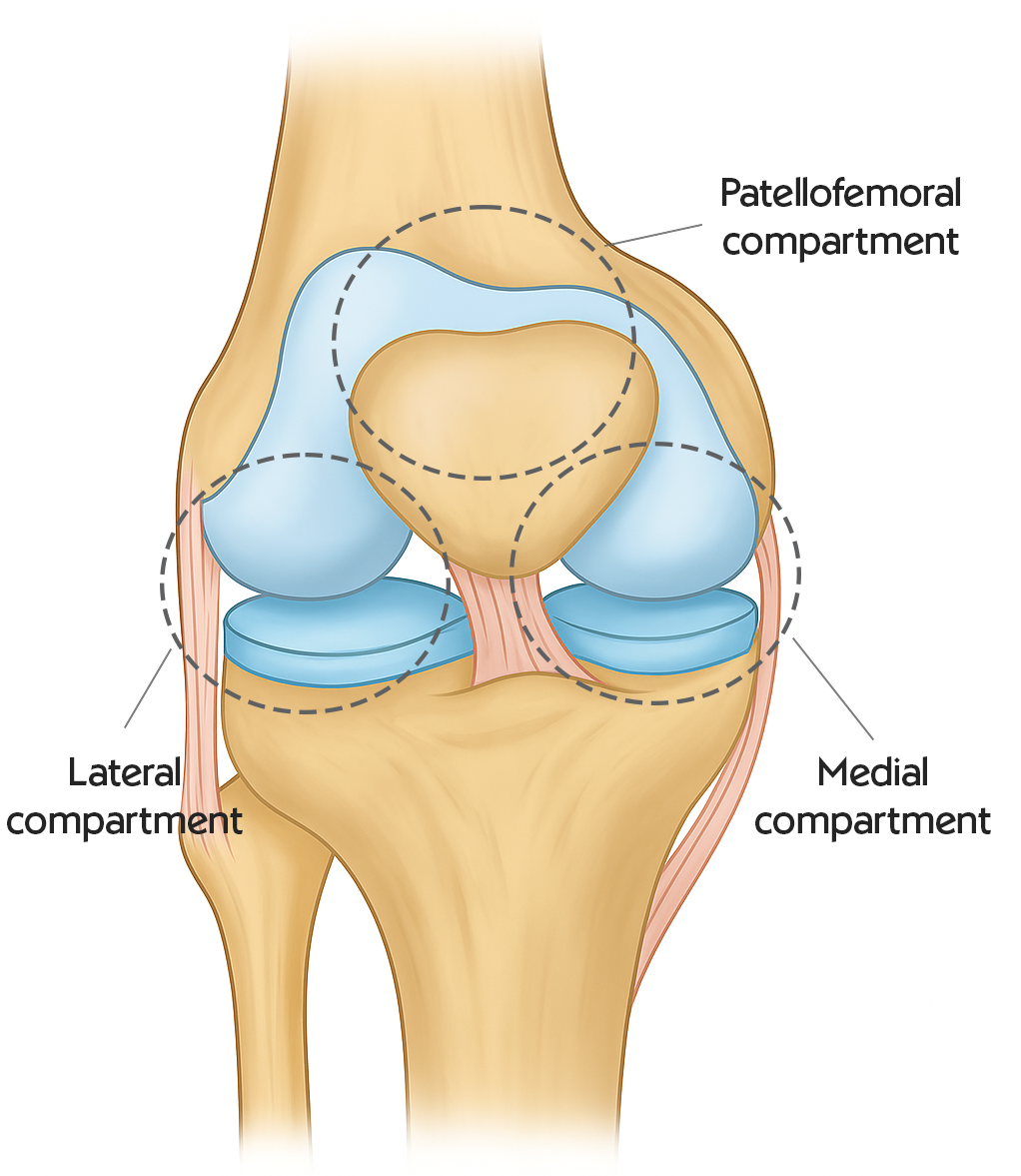
There are two different types of revision knee replacement surgery, and it’s important not to confuse them with one another as they are quite different.
A partial knee replacement is where only one of the parts of the knee has been replaced (usually the medial compartment/inside part of the joint). For some patients, further surgery is needed when the implant wears or loosens, or if arthritis progresses to other parts of the knee. In these cases, a partial knee replacement can be converted to a total knee replacement. This follow-up operation is considered to be a revision.
When a total knee replacement requires revision, this is usually a larger procedure where all parts (compartments) of the knee are removed and replaced. Usually, the new replacement requires additional fixation within the bone using metal augments and stems.
Who is a good candidate for revision knee replacement?
If you have symptoms of a failed knee replacement, you might automatically assume that you’ll be a good candidate for revision knee surgery. However, since the surgery itself is more complex than your initial knee replacement surgery, the eligibility criteria is slightly stricter. You will also need:
- to be in reasonably good general health
- good quality bone otherwise, bone grafting may be required
- commitment to another extensive rehabilitation period
- realistic expectations, as your range of motion may not be as good as it was after your initial surgery.
Who is less suitable for revision knee replacement?
You would be less suitable for revision knee replacement surgery if the following features are present, mainly due to the increasing complexity of the surgery:
- have an active infection
- lack good quality bone in your knee joint
- have problems with your ligaments and tendons in your knee that mean that the joint is unstable
- have other chronic health problems, particularly if they are uncontrolled
- are overweight/obese
- are unable to commit to an extensive rehabilitation period.
Complex surgeries can still be performed, however, it is more likely that you would need to be referred to a major revision knee centre for complex surgery.
Before you can get a revision knee replacement, you’ll need to have a consultation with your orthopaedic surgeon, who will be able to advise you if you’re a suitable candidate for the procedure.
What are the alternatives to revision knee replacement?
Since replacement surgery is usually the last line of treatment for a severely degenerated or damaged knee joint, you’ve probably already tried many of the alternative therapies. These are typically:
- Physical therapy designed to help strengthen the muscles, tendons and ligaments around the joint to provide extra stability.
- Pain medications, including anti-inflammatories, to help keep discomfort and swelling under control.
- Knee bracing may be appropriate to help provide some stability to the joint.
How can I prepare for revision knee replacement?
You can prepare for revision knee replacement surgery in much the same way as you did for regular knee replacement surgery.
What happens at my revision knee replacement pre-operative assessment?
Again, preparation for revision knee replacement surgery is extremely important as studies show that the right preparatory steps can significantly help reduce your risk of complications and improve your recovery.
These steps include:
- strengthening your knee joint using a combination of low-impact cardio, physical therapy exercises and stretches
- reducing your alcohol intake
- maintaining a healthy weight and eating a balanced and nutritious diet
- stopping smoking, since smoking has been proven to increase your risk of complications and delay recovery.
Since recovery from revision knee replacement surgery is extensive, it can also be very helpful to take steps to prepare things at home, such as batch-cooking microwavable meals, or asking friends/family to come in and help clean or drive you to appointments.
Finally, you could potentially be asked to stop taking some of your regular medications ahead of your surgery. This will be discussed with you, including the timeline for when to stop them. In some cases, it may be necessary to switch to a different medication. Again, your consultant will discuss this with you.
What happens during revision knee replacement?
The process of revision knee replacement surgery shares many similarities with your initial surgery. However, it is significantly more complicated, will take longer and will be designed around your specific revision needs. Generally, you can expect the old failing implant to be removed, along with any deteriorating bone.
The implants themselves are often larger too, with augments and longer stems that anchor deeper and more securely into the bone.
As with your initial surgery, this procedure will take place under general anaesthetic or spinal anaesthesia combined with sedation, meaning that you’ll be asleep and unable to feel anything for the duration of your surgery. The procedure itself will be longer too, with most taking an average of three hours.
Is revision knee replacement painful?
Since it’s carried out under anaesthetic, the surgery itself won’t be painful. However, it’s very normal to experience post-operative pain, and this is usually worse in the days and weeks immediately after your procedure. You’ll be prescribed fairly strong painkillers to help keep you comfortable. You must take your pain medications exactly as described to keep your discomfort under control and manageable. And over time, you should be able to reduce their use.
If you have any concerns about your pain, always speak to your Nuffield Health medical team.
How long does revision knee replacement take?
Revision knee replacement usually takes longer than an initial partial or total knee replacement since it’s considerably more complex. In most cases, revision knee surgery takes around two to three hours.
How soon can I go home after revision knee replacement?
Exactly how soon you can go home after your revision knee replacement surgery will depend on your initial recovery, but most people can return home within two to three days.
How long does it take to recover after revision knee replacement?
You can expect your recovery from revision knee replacement surgery to take considerably longer than your initial surgery. Again, this is due to the additional complexity of the surgery.
Every case is different, but here’s an example of a typical revision knee replacement surgery recovery timeline:
The first 6 weeks
6 weeks - 3 months
3 months - 6 months
6 months - 12 months
After six weeks you may be able to start walking without crutches, but there’s still a long way to go in your recovery.
Physiotherapy exercises will focus on improving range of motion and building strength in the joint.
You may be able to start significantly reducing your need for pain medication.
Physiotherapy exercises will focus on improving range of motion and building strength in the joint.
You may be able to start significantly reducing your need for pain medication.
Life might start to feel like it’s getting back to normal.
If you’re in a job that involves manual labour, you should be able to get back to work by the end of this period.
Gentle, low impact exercise should be possible, such as walking, swimming and stationery cycling.
If you’re in a job that involves manual labour, you should be able to get back to work by the end of this period.
Gentle, low impact exercise should be possible, such as walking, swimming and stationery cycling.
The final six months are when the remainder of the swelling and final healing will take place.
Day to day activities should get progressively easier and more comfortable.
It can take up to 12 months for you to be able to enjoy high-impact activities again.
Day to day activities should get progressively easier and more comfortable.
It can take up to 12 months for you to be able to enjoy high-impact activities again.
How soon can I drive after revision knee replacement?
Exactly how soon you’ll be able to get back to driving after your revision knee replacement surgery will depend on your rate of recovery. Your consultant will need to be satisfied that you can accelerate and brake safely – and quickly if necessary. You’ll also need to not be on any medications that could impair your judgement. Always get permission from your consultant (surgeon), otherwise your insurance could be invalidated.
What exercises should I do after revision knee replacement?
You’ll be given a personalised physical therapy rehabilitation programme immediately after surgery. This will be comprised of a range of different exercises designed to improve the range of motion in your knee, build strength in the joint and help you return to normal daily activities that will restore your quality of life.
When can I take a shower or bath after revision knee replacement?
It’s important not to get your knee wet for at least 24-48 hours, but after this time you should be able to shower. You’ll be advised not to soak the incisions until they are fully healed, which could take six to eight weeks.
How can I minimise recovery time after revision knee replacement?
There’s no getting around the fact that revision knee replacement has a lengthy recovery period. However, you can help ensure that it’s not longer than it needs to be by following all of your post-operative care instructions regarding taking care of your knee – from protecting the joint from infection, to completing all your physical therapy exercises.
What should I avoid after revision knee replacement?
What you should avoid after revision knee replacement surgery is the same as what you were told to avoid after your initial partial or total knee replacement surgery. These include:
- doing too much too soon
- trying to stop or reduce pain relief too quickly
- failing to follow your physiotherapy exercises
- not keeping your wound dry and clean
- ignoring any concerns you have – always seek medical advice from your surgery team.
What are the risks and complications of revision knee replacement?
The risks and complications associated with revision knee replacement are pretty much the same as those you were made aware of when you had your initial surgery – things like bleeding, bruising and infection at the wound site, damage to soft tissue inside the knee joint. Complications such as nerve injury, bloods clots and medical complications can occur after surgery.
There are also some more specific complications to consider, including joint stiffness. This can occur as a result of excessive scar tissue, which can build up more significantly the more surgeries you have. Instability and loosening are another concern, which can happen either as a result of implant failure (rare) or deterioration of bone that causes the fixings to come loose.
Your consultant will explain all risks and complications to you in detail, and you can ask any questions that you may have. Due to the longer and more complicated surgery involved with revision knee replacement surgery, the risks are generally higher than after your first surgery.
What is the success rate of a revision knee replacement?
Between 75% and 90% of revision knee replacements are still working successfully ten years after surgery. Of those patients, 70 - 90% report significant improvement in their quality of life, citing less pain and better mobility. However, success rates do vary by patient and depend on you following all your post-operative instructions and comprehensive rehabilitation programme.
Can a revision knee replacement come loose over time?
Yes, a revision knee replacement can come loose over time, but it’s not overly common. One study suggests that between 10% and 35% of revision knee replacements may experience aseptic loosening over time, where the implant comes away from the bone without any evidence of infection. Risk factors for a revision knee replacement coming loose include pre-existing bone loss, being significantly overweight or regularly taking part in high-impact exercise.
How much does a revision knee replacement cost at Nuffield Health?
For pricing information, please get in touch with your local Nuffield Health hospital. The hospital or your healthcare team will give you a fixed, all-inclusive price for the treatment following your initial consultation.
Sources
1. https://gettingitrightfirsttime.co.uk/wp-content/uploads/2026/03/National-revision-knee-surgery-prog...
2. https://pubmed.ncbi.nlm.nih.gov/15552150/
3. https://www.sciencedirect.com/science/article/abs/pii/S1742706113002377
4. https://pmc.ncbi.nlm.nih.gov/articles/PMC5813428/
5. https://pmc.ncbi.nlm.nih.gov/articles/PMC7390160/
6. https://pubmed.ncbi.nlm.nih.gov/39778235/
7. https://www.who.int/news/item/20-01-2020-smoking-greatly-increases-risk-of-complications-after-surge...
8. https://pmc.ncbi.nlm.nih.gov/articles/PMC8611497/
9. https://pmc.ncbi.nlm.nih.gov/articles/PMC7612217/
10. https://pmc.ncbi.nlm.nih.gov/articles/PMC9311120/
11. https://www.thelancet.com/journals/lancet/article/PIIS0140-6736(18)32531-5/fulltext
FAQs
-
Are robotic assisted revision knee replacements available?
Yes, you can get robotic-assisted partial and total knee replacements. This is where robotic technology is used to plan and assist your consultant with the surgery. This technology is still developing, so it is important to discuss this with your consultant (surgeon).
-
Will the surgeon remove all of the old knee implant or only part of it?
This really depends on the extent of the damage to the old knee implant. Your consultant will be able to advise you exactly what you can expect from your procedure.
-
How long does a revision knee replacement typically last?
This depends upon the complexity of the revision surgery that is going to be performed. Typically 8 out of 10 revision knee replacements should last more than 10 years.
-
How many times can a knee replacement revision be done?
A knee replacement can be revised a number of times. However, it’s important to note that success and longevity rates have been shown to decrease each time a revision surgery is done.
-
Will my revised knee feel different from my original knee replacement?
It may do. Not only does revision knee replacement surgery usually require a longer and more intensive recovery period, but many patients also report that their revised knee feels different. Some cite that it seems heavier or stiffer, while others say that their mobility isn’t as good10. This could be due to more specialised implants being used, or due to additional scar tissue formation because of multiple surgeries.
-
What happens if a knee revision fails?
Failing revision surgery isn’t common, but if your procedure is unsuccessful, you have a limited number of options to help treat your pain and mobility issues. These could involve another attempt at revision surgery, long-term antibiotic treatment to try and resolve a chronic infection, or as a very last resort, knee fusion surgery (which completely eliminates movement in the knee joint) or amputation.
Ways to pay
Nuffield Health promise
Our prices are all-inclusive. We will equal any comparable price. There are no time limits on your aftercare.
Paying for yourself
There are no hidden costs in our treatment prices. The price you see is the price you pay.
Find out morePersonal medical loan
Spread the cost of your treatment with a 10, 12 or 24 month 0% personal medical loan.
Find out moreMedical insurance
We work with you and your insurance provider to get you the treatment you need quickly.
Find out more