
Myelopathy treatment (spinal cord compression treatment)
- Overview
Reviewed on Sunday 1 November 2026 by Mr Gordan Grahovac, Consultant Neurosurgeon and Complex Spinal Surgeon at Nuffield Health Tunbridge Wells Hospital.
Changes in balance, coordination or hand function can be worrying. These may be signs of myelopathy, a condition caused by pressure on the spinal cord. At Nuffield Health, our spinal specialists offer a full range of treatments for myelopathy, from conservative care to advanced surgical procedures. Your consultant will assess your symptoms, scans and overall health to determine the safest and most effective treatment plan for you.
What is myelopathy treatment?
Myelopathy treatment focuses on relieving pressure on the spinal cord, reducing inflammation and preventing further nerve damage. Depending on the cause and severity, treatment may involve non-surgical management, surgery, or a combination of both.
What is myelopathy (spinal cord compression)?
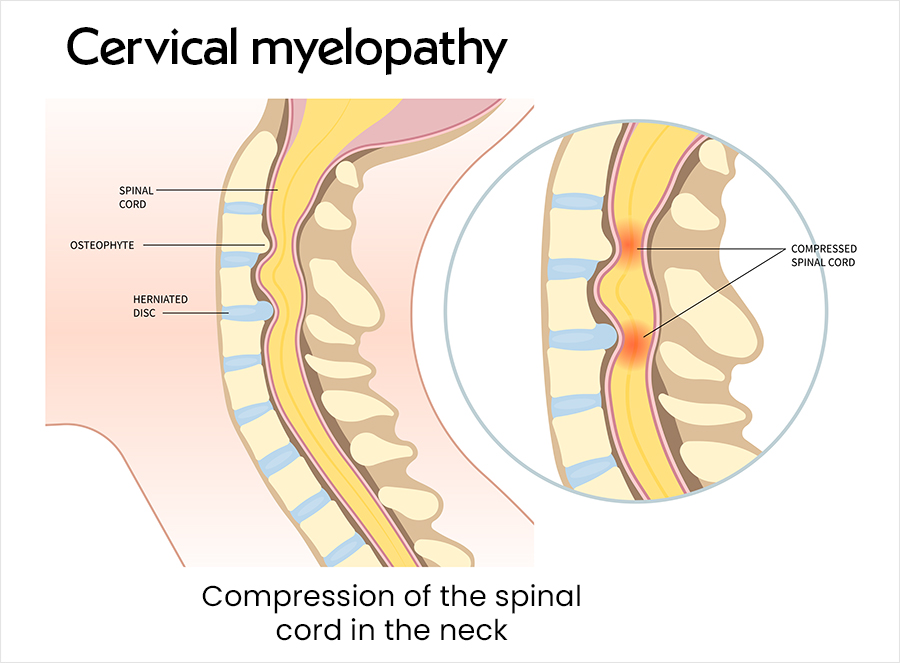
Myelopathy occurs when the spinal cord – the main communication pathway between your brain and body – becomes compressed. This can happen in the cervical spine (neck) or the thoracic spine (mid-back).
Compression can be caused by:
- Degenerative changes (wear and tear)
- Herniated discs
- Bone spurs
- Thickened ligaments
- Trauma
- Arthritis
- Spinal deformity.
Because the spinal cord controls movement and sensation, myelopathy can affect many aspects of daily life.
What are the different types of myelopathy?
- Cervical myelopathy: This type of myelopathy occurs in the neck and is the most common form. It can affect hand coordination, balance and walking.
- Thoracic myelopathy: Occurs in the mid-back. It’s less common but can cause leg weakness, stiffness and changes in walking pattern.
What causes myelopathy?
Common causes include:
- Age-related spinal degeneration
- Herniated discs
- Spinal stenosis (narrowing of the spinal canal)
- Bone spurs
- Thickened ligaments
- Rheumatoid arthritis
- Trauma or injury
- Tumours or cysts (less common).
What are the symptoms of myelopathy?
Symptoms vary depending on where the spinal cord is compressed, but may include:
- Difficulty with balance or walking
- Weakness in the arms or legs
- Numbness or tingling
- Loss of fine motor skills (e.g., buttoning clothes)
- Neck pain or stiffness
- Changes in bladder or bowel control
- Electric shock sensations down the spine (Lhermitte’s sign).
How serious is myelopathy?
Myelopathy is considered a serious condition because the spinal cord cannot regenerate once damaged. Without treatment, symptoms may worsen over time and lead to permanent spinal cord injury.
Early diagnosis and treatment offer the best chance of protecting long-term function.
Who is at risk of developing myelopathy?
You may be more at risk if you:
- Are aged 50 and over
- Have arthritis or severe spinal degeneration
- Have a history of spinal injury
- Have congenital spinal canal narrowing
- Have inflammatory conditions such as rheumatoid arthritis.
What are the treatment options for myelopathy?
Treatment depends on the severity of symptoms and the underlying cause.
Non-surgical treatment for myelopathy
Non-surgical options may help manage symptoms in mild cases when symptoms are not significantly affecting quality of life:
- Physiotherapy: Helps maintain mobility, balance and strength, but cannot reverse spinal cord compression.
- Medication: Pain relief, anti-inflammatories, or neuropathic pain medication may be recommended.
It’s important to note that non-surgical treatments can help manage symptoms, but they cannot decompress the spinal cord. If compression is significant, surgery is usually recommended.
Surgical treatments for myelopathy
When myelopathy is caused by significant spinal cord compression, surgery is the most effective way to protect long-term spinal cord function. The aim of surgery is twofold:
- Relieve pressure on the spinal cord (decompression)
- Stabilise the spine to prevent further damage.
Your consultant will recommend the most appropriate procedure based on the location of compression, your symptoms, your scans, and your overall health. In many cases, more than one technique may be used during the same operation.
Anterior Cervical Discectomy and Fusion (ACDF)
What it involves
- The surgeon approaches the spine from the front of the neck
- A damaged or herniated disc pressing on the spinal cord is removed
- A small spacer or bone graft is inserted
- A plate and screws are used to fuse the vertebrae together.
Why it’s used
- Removes the source of compression
- Restores stability
- Helps prevent further disc collapse.
ACDF is often recommended when the compression is caused by a disc bulge or bone spurs at the front of the spine.
Laminoplasty
Laminoplasty is commonly used for cervical myelopathy, especially when multiple levels of the spine are affected.
What it involves
- The lamina (the back part of the vertebra) is hinged open like a door
- This widens the spinal canal and creates more space for the spinal cord
- Small plates or bone wedges hold the lamina in its new position.
Why it’s used
- Preserves more natural movement than fusion
- Ideal for multi-level compression
- Reduces pressure without removing large amounts of bone.
Laminectomy
A laminectomy removes part of the vertebral bone (the lamina) to relieve pressure on the spinal cord.
What it involves
- The lamina is removed to open up the spinal canal
- Ligaments pressing on the spinal cord are removed
- Fusion may be added if the spine needs extra stability.
Why it’s used
- Creates immediate space for the spinal cord
- Effective for both cervical and thoracic myelopathy
- Often used when compression is caused by thickened ligaments or bone overgrowth.
Discectomy
A discectomy removes part of a herniated disc that is pressing on the spinal cord.
What it involves
- The surgeon removes the portion of the disc causing compression
- The approach is from the front (anterior)
- Fusion may be performed at the same time if stability is needed.
Why it’s used
- Ideal when a disc bulge is the main cause of myelopathy
- Helps relieve pressure quickly
- Often combined with ACDF in the neck.
How your consultant chooses the right procedure
Your surgeon will consider:
- Where the compression is (neck or mid-back)
- How many levels are affected
- Whether the spine is stable
- Your symptoms and neurological findings
- Your MRI or CT scan results
- Your overall health and bone quality.
In some cases, a combination of procedures, such as laminectomy plus fusion, may be recommended to achieve the best long-term outcome.
When should you consider myelopathy surgery?
Myelopathy surgery is usually recommended when there is clear evidence of spinal cord compression and symptoms are affecting daily life, balance, coordination or fine motor skills. Because the spinal cord cannot regenerate once damaged, early intervention is often key in preventing long-term disability.
You may be advised to consider surgery if:
- Your symptoms are worsening over time
- You have moderate to severe neurological changes (e.g., weakness, clumsiness, gait problems)
- MRI or CT scans show significant spinal cord compression
- Non-surgical treatments have not improved your symptoms
- You are at risk of permanent nerve damage without intervention.
Surgery is not always urgent, but delaying treatment can reduce the chance of full neurological recovery.
Who is suitable for myelopathy surgery?
You may be suitable for surgery if:
- You have confirmed cervical or thoracic myelopathy
- Your symptoms are interfering with daily activities
- You have weakness, balance issues or coordination problems
- Imaging shows compression that can be surgically relieved
- You are in good enough health to undergo surgery.
Your consultant will assess your overall fitness, medical history and imaging to determine suitability.
Who may not be suitable?
Surgery may not be recommended if:
- You have severe medical conditions that make anaesthesia unsafe
- The spinal cord damage is too advanced to benefit from decompression
- You have an active infection
- Your symptoms are mild and stable.
In these cases, your consultant may recommend non-surgical management and close monitoring.
How can I prepare for myelopathy surgery?
Preparing well can help ensure a smooth procedure and recovery. Your healthcare team will guide you through each step, but preparation often includes:
- A pre-operative assessment
- Blood tests, ECG or imaging
- Reviewing your medications
- Stopping certain drugs (e.g., blood thinners)
- Fasting instructions before anaesthesia
- Arranging time off work
- Planning for help at home in the early days
- Ensuring someone can take you home after surgery.
Your consultant will give personalised advice based on your health and the type of surgery planned.
What happens at my myelopathy surgery consultation?
Your consultation is your opportunity to understand your diagnosis and treatment options clearly. During this appointment, your consultant will:
- Review your symptoms and how they affect daily life
- Examine your spine, reflexes, strength and coordination
- Review MRI or CT scans in detail
- Explain the cause of your spinal cord compression
- Discuss the recommended surgical procedure
- Outline risks, benefits and alternatives
- Answer any questions you may have.
Many patients find it helpful to bring a list of questions or a family member for support.
What happens during myelopathy surgery?
The exact steps depend on the type of surgery (ACDF, laminectomy, laminoplasty, fusion or discectomy), but the goals are always the same: relieve pressure on the spinal cord and stabilise the spine.
Myelopathy surgeries are performed under general anaesthetic, so you will be asleep and comfortable throughout. Depending on the complexity and number of levels treated, surgery may take 1–3 hours.
During the procedure
Your surgeon may:
- Remove bone, disc material or thickened ligaments pressing on the spinal cord
- Widen the spinal canal to create more space
- Insert screws, plates or grafts to stabilise the spine
- Restore alignment if needed.
You will then be moved to the recovery area, where your vital signs are monitored as you wake up.
Is myelopathy surgery painful?
You won’t feel pain during the procedure. Afterwards, it’s normal to experience some discomfort around the incision and muscles, which can be managed with pain relief.
My recovery from myelopathy surgery
Recovery varies depending on the type of surgery, your general health and how long the spinal cord has been compressed.
Going home
- Some patients go home the same day
- Others may stay 1–2 nights for monitoring.
Returning to activities
- Light activities: Within a few days
- Desk-based work: 2–4 weeks
- Manual work: 6–12 weeks
- Driving: Once you can move comfortably and safely, you’re able to resume driving, but your consultant will confirm.
- Exercise: You can gradually return to exercise under physiotherapy guidance.
What to avoid
- Heavy lifting
- High-impact exercise
- Twisting or bending movements
- Prolonged sitting in the early weeks.
Your consultant and physiotherapist will tailor your recovery plan to your needs.
What are the benefits of myelopathy surgery?
Surgery aims to:
- Relieve pressure on the spinal cord
- Prevent further neurological deterioration
- Improve balance, coordination and mobility
- Reduce pain, numbness or weakness
- Protect long-term spinal cord function
- Improve quality of life.
How soon will I feel the benefits of myelopathy surgery?
Some improvements, such as reduced pain or better balance, may be noticeable within days or weeks. Spinal cord recovery can continue for months, and some symptoms may keep improving over time.
How long do the results of myelopathy surgery last?
Results are typically long-lasting, especially when combined with physiotherapy and lifestyle changes that support spinal health.
What are the risks and possible complications of myelopathy surgery?
General risks may include:
- Pain
- Bleeding
- Infection
Procedure-specific risks may include:
- Nerve irritation
- Weakness or numbness
- Spinal fluid leak
- Failure to improve symptoms
- Rarely, worsening neurological function.
What is the success rate of myelopathy surgery?
Myelopathy surgery has a high success rate for preventing further deterioration and improving symptoms in suitable patients.
Can myelopathy return after surgery?
If the underlying cause progresses (e.g., arthritis or degenerative changes), symptoms may recur. Regular follow-up helps monitor long-term spinal health.
How much does myelopathy surgery cost at Nuffield Health?
For pricing information, please contact your local hospital. The hospital or your healthcare team will give you a fixed all-inclusive price for the treatment following your initial consultation.
FAQs
-
How long can you live with cervical myelopathy?
Myelopathy itself is not life shortening, but untreated compression can lead to permanent disability.
-
Does early treatment for myelopathy lead to better outcomes?
Yes, early diagnosis and treatment are strongly linked to better long term results.
-
What’s the difference between myelopathy and radiculopathy?
Myelopathy affects the spinal cord while radiculopathy affects a nerve root.
-
Will I need physiotherapy after myelopathy surgery?
Most patients benefit from physiotherapy to improve strength, balance and mobility.
-
What lifestyle changes can help manage myelopathy?
Maintaining a healthy weight, staying active, avoiding smoking and practising good posture can support long term spinal health.
Ways to pay
Nuffield Health promise
Our prices are all-inclusive. We will equal any comparable price. There are no time limits on your aftercare.
Paying for yourself
There are no hidden costs in our treatment prices. The price you see is the price you pay.
Find out morePersonal medical loan
Spread the cost of your treatment with a 10, 12 or 24 month 0% personal medical loan.
Find out moreMedical insurance
We work with you and your insurance provider to get you the treatment you need quickly.
Find out more