
Hernia repair
- Overview
A hernia is a weak spot in the abdominal wall that lets tissue push through and form a lump. Find out what the main types of hernia are, how repair surgery works and what recovery involves.
What is a hernia?
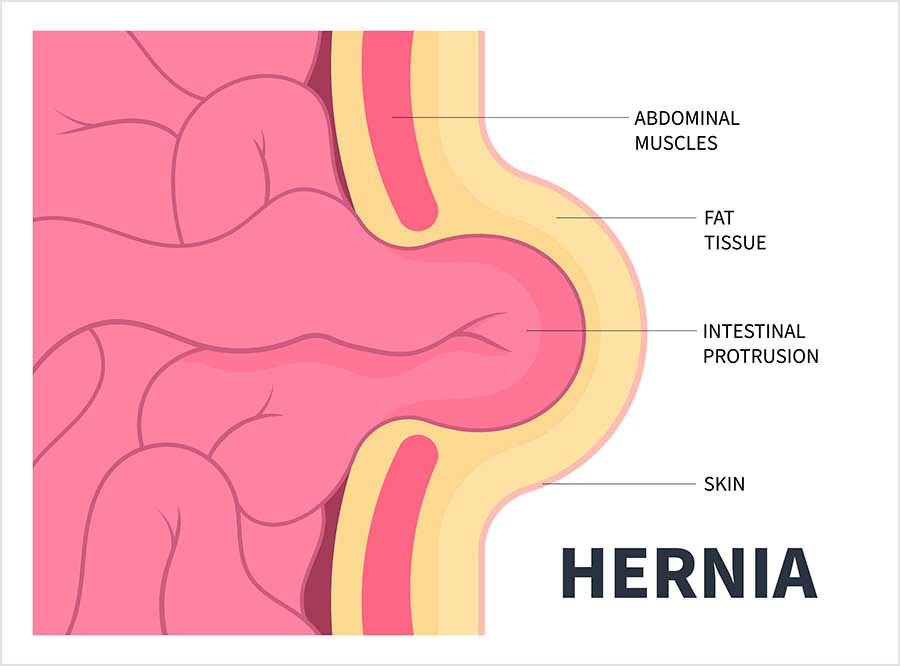
A hernia is a bulge that forms when fatty tissue, bowel or another organ pushes through a weak area in the surrounding muscle wall. You may notice a lump that comes and goes, often showing when you cough or strain and settling when you lie down.
Most untreated hernias are not dangerous, but they can become bigger and painful. In adults, an abdominal wall hernia does not close without surgery, and over time, it can grow or become painful. Umbilical hernias in young children are the exception, as many close by themselves.
If the tissue inside the hernia is incarcerated (stuck) or strangulated (blood supply cut off), this can become a medical emergency.
Call 999 or go to your local A&E straight away if:
- The pain comes on suddenly, is severe and keeps getting worse
- The skin over the lump changes colour, going pale and then red, purple or dark
- The lump becomes hard or tender, or cannot be pushed back in.
You should also seek medical attention if you have a hernia and:
- You feel sick or are sick
- You have a swollen or bloated tummy
- You are constipated or cannot pass wind
- You have a high temperature, or feel hot, cold or shivery
- You have blood in your vomit, or become suddenly confused.
Types of hernia
Hernias are named by where they appear on the body:
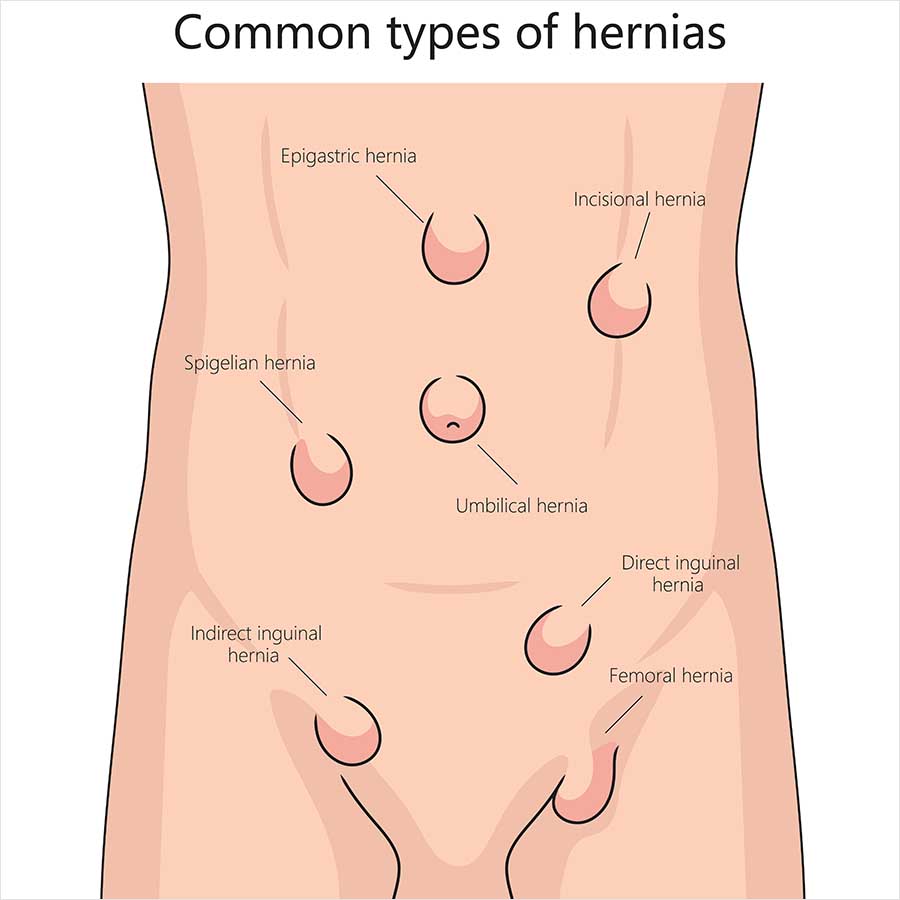
- Inguinal hernia: A lump in the groin, at the inguinal canal. This is the most common type of hernia. It is more common in men because the canal is wider, carrying the spermatic cord and blood vessels that supply the testicles.
- Femoral hernia: A small lump lower in the groin, just below the crease at the top of the thigh, where the femoral artery and vein pass from the abdomen into the leg. It is more common in women, particularly after pregnancy or childbirth.
- Umbilical hernia: A lump at or near the belly button. It is very common in newborns, and many close by the age of 4. In adults, it is more common after pregnancy and in people who are overweight.
- Epigastric hernia: A small, firm lump in the upper middle of the abdomen, between the belly button and the breastbone. These usually contain fatty tissue rather than bowel contents.
- Incisional hernia: A bulge at or near the scar of a previous operation, where the abdominal wall has not healed strongly.
- Hiatus hernia: When part of the stomach pushes up through the diaphragm into the chest.
- Spigelian hernia: A rare type of abdominal wall hernia, where tissue pushes through a weak spot between the muscle fibres at the side of the abdomen.
Hernias can also be grouped depending on how many occur at once:
- Bilateral hernias: This form of hernia presents itself on both sides of the body at the same time
- Unilateral hernias: This type of hernia occurs on one side of the body.
What is hernia repair surgery?
Hernia repair surgery aims to return the contents of the hernia to their normal position and to repair the weakness in the muscle and body wall.
Most hernia surgery is a straightforward day case, performed under general anaesthetic, and you can typically return to light activity within a few days and normal duties within 1–2 weeks, though it may be longer before you can safely lift heavy objects again.
Types of hernia repair surgery
There are several techniques to repair a hernia:
1. Open hernia surgery
Open repair surgery takes about 1 hour.
- Your surgeon will make an incision (cut) in your groin and remove the hernial sac
- They'll use stitches to strengthen the muscle layer
- Finally, they'll insert a synthetic mesh to cover the weak spot.
2. Laparoscopic (keyhole) hernia surgery
Laparoscopic hernia repair usually takes about 1 hour.
- Your surgeon will insert a laparoscope (tiny telescope) connected to a camera via a very small tube (cannula)
- They'll close the weak spot from inside your abdomen
- Finally, they'll use a piece of surgical mesh and surgical staples to reinforce the area.
3. Robotic-assisted hernia surgery
Robotic-assisted hernia repair is a form of keyhole surgery. It usually takes under an hour, but can take longer for larger or more complex hernias.
- Your surgeon will make several small incisions (cuts) near your belly button, then gently fill your abdomen with carbon dioxide gas to create working space.
- They'll pass a camera and robotic instruments through the incisions, and use them to free the hernia and return its contents to the abdomen.
- Finally, they'll place a mesh over the weak spot and close the incisions with stitches or glue.
How fast is the recovery after hernia surgery?
Recovery time from hernia repair surgery is usually quick for most people, but a full return to heavy lifting and strenuous exercise takes around six weeks or longer.
- Going home: Most people go home the same day as their surgery. Some stay one night, particularly after incisional or epigastric hernia repair.
- Daily activities: After groin hernia repair (inguinal or femoral), most people are back to normal daily activities within about a week. Walking is encouraged from day one for all hernia types.
- Work: Desk-based work can often restart after 2 weeks. Manual work can take around 6 weeks. Please speak to your consultant (surgeon) about when you should return to work.
- Heavy lifting or strenuous exercise: Avoid these for around 6 to 8 weeks.
- Showering and baths: You can usually shower after 48 hours. Avoid baths, pools and hot tubs for 2 weeks.
- Driving: You can drive once you can control the car safely, which is often about a week after surgery. Check with your insurer first, as some policies require a longer wait.
Why choose Nuffield Health for your hernia repair?
Hernia repair surgery at Nuffield Health is like nowhere else. We’ll support you every step of the way, making sure you get the best treatment and encouraging a speedy recovery.
We offer you:
- Competitive all-inclusive pricing
- Quick access to treatment
- Exceptional matron-led care
- First-class patient accommodation
- Flexible visiting hours
- As much aftercare as you need at no extra cost, where clinically required.
Ways to pay
Nuffield Health promise
Our prices are all-inclusive. We will equal any comparable price. There are no time limits on your aftercare.
Paying for yourself
There are no hidden costs in our treatment prices. The price you see is the price you pay.
Find out morePersonal medical loan
Spread the cost of your treatment with a 10, 12 or 24 month 0% personal medical loan.
Find out moreMedical insurance
We work with you and your insurance provider to get you the treatment you need quickly.
Find out more