
Anti-VEGF intravitreal injections for wet age-related macular degeneration
- Overview
Reviewed on Saturday 10 October 2026 by Dr Meg Das, Consultant Ophthalmologist (Medical Retina) at Nuffield Health Edinburgh Hospital.
Wet age-related macular degeneration (wet AMD) can affect your central vision quickly, so early assessment and treatment matter. Anti-VEGF injections are given into the eye to reduce leaking from abnormal blood vessels at the back of the eye, with the aim of protecting your sight. At Nuffield Health, our consultant ophthalmologists can assess your eyes, explain your treatment options and support you through your injections and follow-up.
What are intravitreal injections for macular degeneration?
Anti-VEGF medicines are injected into the eye (an intravitreal injection) to treat wet age-related macular degeneration (wet AMD). They aim to stabilise vision and may improve it in some people. Early assessment and treatment matter because untreated wet AMD can damage central vision within days or weeks.
What are intravitreal injections for macular degeneration also known as?
An intravitreal injection describes how a medicine is delivered into the vitreous gel inside the eye. Anti-VEGF is the type of medicine commonly injected for wet AMD; not every intravitreal injection contains an anti-VEGF medicine.
How do anti-VEGF injections work?
VEGF (vascular endothelial growth factor) encourages abnormal blood vessels to grow and leak beneath or within the macula. Anti-VEGF medicines block this signal, reducing leakage and helping to protect central vision. Treatment often starts with injections about every four weeks and then the interval between injections, depends on the medicine and the eye's response, assessed with vision tests and OCT scans.
What anti-VEGF drugs are used in intravitreal injections?
Medicines used for wet AMD include aflibercept, ranibizumab, faricimab, bevacizumab and brolucizumab. Availability, licensing, suitability and the choice of drug vary. Your ophthalmologist will explain the medicine proposed for you, its expected benefits and its particular risks.
What is wet age-related macular degeneration?
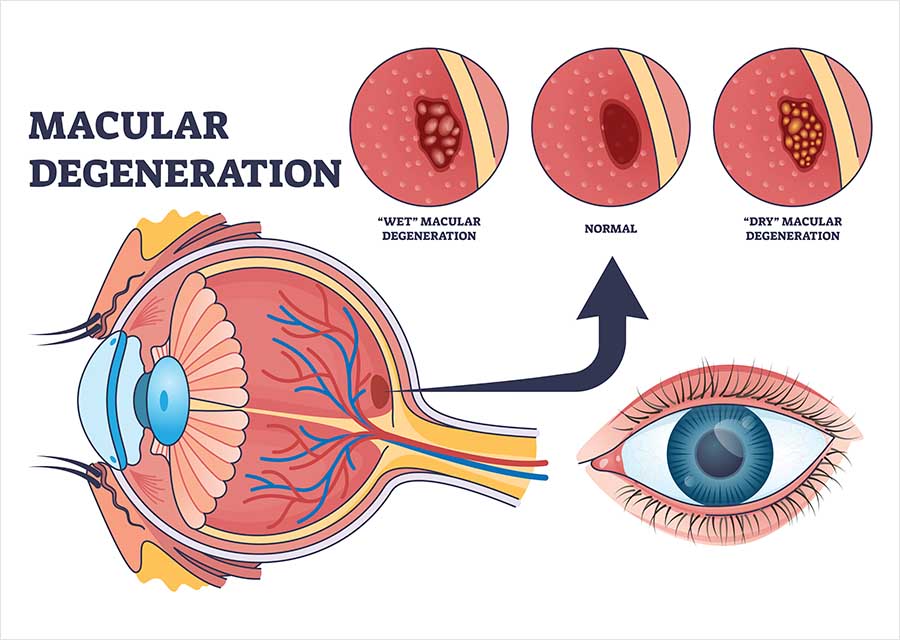
Wet age-related macular degeneration (AMD) occurs when abnormal blood vessels develop beneath or within the macula, which is the central part of the light-sensitive retina. Leakage or bleeding can rapidly affect reading, recognising faces and other detailed vision. Dry AMD involves different changes in the macula and can progress slowly. In some people, dry AMD can develop into wet AMD.
What causes macular degeneration?
Age-related macular degeneration is mostly caused by the natural ageing process, with people over the age of 65 most often affected3. Other common causes of AMD include:
- Smoking. People who smoke are up to four times more likely to develop age-related macular degeneration.
- A family history of AMD. You’re more likely to develop AMD if a close blood relative also has the condition.
- Chronic health conditions, such as obesity and high blood pressure.
- Lack of sun protection. Studies suggest that UV exposure could make AMD more likely.
What are the symptoms of macular degeneration?
If you experience any of these symptoms, it’s important to make an appointment with an optometrist or ophthalmologist to get checked out.
How is macular degeneration diagnosed?
You can only be diagnosed with macular degeneration by a specialised eye clinician – either an optometrist or ophthalmologist. They’ll meet with you to discuss your symptoms and will perform a range of tests to confirm your diagnosis. These will include:
- Visual acuity testing: You’ll be more familiar with this as the letter chart that’s usually used to assess your vision when you go to the optician.
- Amsler grid testing: This is designed to assess whether your central vision is distorted.
- A dilated eye exam: This is where drops are placed into your eyes to widen your pupil (the dark coloured dot in your eye) so that your eye doctor can look through it to the structures at the back, including your retina and macula.
- Optical Coherence Tomography (OCT): This is a non-invasive test that takes detailed, high-resolution images of your retina to enable early disease detection.
- Fluorescein angiography: This test is specifically designed to diagnose wet AMD. A yellow dye will be injected into a vein in your arm. This will travel to the blood vessels in your eye to highlight where they are leaking. Fluorescein angiography or other types of imaging are used when the diagnosis or treatment plan needs clarification; it is not required for every patient.
What happens if macular degeneration is left untreated?
If macular degeneration is left untreated, your vision will get considerably worse over time, probably reaching a point where it will be difficult to enjoy many of your day-to-day activities, such as reading, driving and eventually even being able to recognise different people. This is because the level of detail that you’ll be able to see will continue to decrease.
It’s important to remember that with wet AMD, your vision will deteriorate much more quickly than it would with the dry version of the condition. This makes it paramount that you get treatment for wet AMD quickly, before you experience irreparable damage to your eyesight.
Who is suitable for anti-VEGF injections (intravitreal) for macular degeneration?
If you’ve been diagnosed with wet AMD, you’re probably a good candidate for anti-VEGF injections, unless you have:
- an active infection
- severe inflammation of the eye (uveitis)
- recently had a heart attack or stroke (in the last three months)
- an allergy to any of the ingredients in the medication.
Your specialist eye doctor will be able to advise you if intravitreal injections are a viable treatment for your macular degeneration.
What are the alternatives to anti-VEGF injections (intravitreal) for macular degeneration?
If you’re not a suitable candidate for anti-VEGF injections, there are some alternatives that may be considered. These include:
- Photodynamic therapy: This is a form of laser treatment that works alongside a drug called verteporfin, which is injected into a vein to break down and destroy abnormal blood vessels in the macula.
- Emerging therapies: Medical technological innovation continues to evolve, and there are new emerging treatments for a range of conditions being developed all the time. Your consultant may be able to introduce one or more of these as alternatives to anti-VEGF injections.
Some people may be monitored without injections if the disease is inactive or treatment is unlikely to help.
How should I prepare for anti-VEGF injections?
There are a few things that you should do before your appointment to get an anti-VEGF injection that will help to ensure that your procedure goes as smoothly as possible. These are in addition to your consultation appointment, during which you’ll provide details of your medical history. These preparatory steps include:
- Wearing glasses and not contact lenses to your appointment
- Arrange for someone to drive you to your appointment, and bring you home after as the dilating or anaesthetic drops and the injection may temporarily blur your vision
- Letting your eye care team know if anything has changed since your last appointment, especially a new eye infection, redness or discharge, and any previous reaction to any drugs, especially antiseptics or local anaesthetic
- Not wearing makeup or any other cosmetics on your face or eyes
What happens during an anti-VEGF (intravitreal) injection?
Getting an anti-VEGF injection is a straightforward process that can be broken down into the following steps:
- You’ll be made comfortable in a reclining chair, and numbing drops will be administered, which will help ensure you don’t feel any pain when you have your anti-VEGF injection. Your eye pressure may also be taken before the injection is given.
- Your eye and the area around it will be cleaned with an antiseptic like povidone-iodine to help reduce the risk of infection.
- Once your eye is numb, a small device will be placed into your eye to keep your eyelids open and as wide apart as possible.
- The injection will be delivered into the white part of your eye. You may feel pressure or brief discomfort.
- Your eyelid holder will be removed, and the procedure will be complete.
The team checks that you can see afterwards and gives you written aftercare and an urgent contact number.
How long does an anti-VEGF injection take?
The entire procedure, including preparation time and initial recovery phase, usually takes less than an hour. However, always seek more specific advice from your care team.
Are anti-VEGF injections painful?
The eye is numbed with anaesthetic drops. Many people feel pressure or brief discomfort, and the eye may feel gritty or sore afterwards. Let the team know if an injection is painful or if pain increases after you leave.
How long does it take to recover from anti-VEGF injections (intravitreal) for macular degeneration?
Recovery from intravitreal injections is usually very quick, with most patients able to get back to their usual daily activities, including driving, within around 48 hours. It’s normal to experience some discomfort during this time, and over-the-counter pain relief is usually strong enough to help ease this. Your vision might not seem quite as good as usual for the first few days. A mildly gritty, watery or red eye and a few small temporary floaters can be normal. A small blood spot on the white of the eye may take a week or two to clear. Avoid rubbing the eye, especially while it is numb. Follow your own clinic's instructions on washing, eye makeup, contact lenses and swimming, as local aftercare intervals differ.
When can I return to work after anti-VEGF injections?
If you have a sedentary job, you can probably go back to work the day after your anti-VEGF injection. However, if your job involves heavy lifting or other intense manual activity, exposure to dust, heat or water, you may need to take a few additional days off.
When can I drive after anti-VEGF injections?
Most people can return to driving around 24 hours after their wet AMD eye injection, but exact timelines can vary between individuals. You should make sure that you meet the legal standard required for driving; otherwise, your insurance could be invalidated.
When can I exercise after anti-VEGF injections?
You can do light activities such as walking or yoga within 48 hours of your anti-VEGF injection. However, you’ll need to avoid getting water in your eye for at least the first five days to help protect it against infection.
When can I swim after anti-VEGF injections?
You’ll be advised not to swim for at least five days. This is because getting water in your eye could significantly increase your risk of developing an infection.
What are the risks and complications of anti-VEGF (intravitreal) injections?
As with any medical procedure, there is a small risk of complications following anti- VEGF treatment. Most complications that might occur are from the injection itself, rather than the drug. For most patients, the benefit of the treatment outweighs the small risk of injection injury.
The following are some of the major potential risks and side effects of antiVEGF injections. (Please note that this is not a complete list of all risks. For a full list of risks, and further information about the medicine used in your treatment, please see the individual patient information leaflet found inside the drug packet. It is important to note that these risks are all rare, and significant loss of vision due to this treatment is very uncommon.
Some common side effects that could occur include:
- Red eye (there is usually a bleed or bruise on the white part of the eye at the site of injection, which clears in a week or two).
- Sore and gritty eye (slight ache and discomfort lasting a day or two).
- ‘Blobs’ or ‘small specks’ in your vision (‘floaters’) might be seen for a few days after the injection.
You may also experience transient flashing lights or swirls of light immediately after the injection. It is important to note that most of the discomfort relating to injections is due to the use of Povidone Iodine antiseptic. This is a vital part of the injection process and reduces the risk of infection. You may be sensitive to the iodine, so your injecting physician will make sure to wash it out. Please note that allergies to iodine are extremely rare.
Rare risks of anti-VEGF injections:
- Serious eye infection (one in 2,000 cases)
- Detached retina
- Increased eye pressure
- Blood clots and bleeding in the eye
- Inflammation inside the eye
- Cataract.
Seek urgent same-day advice from your consultant or Nuffield Health hospital if pain or redness increases, vision worsens, the eye becomes light-sensitive, or you develop discharge. A sudden shower of floaters, flashes or a curtain over your vision also needs urgent assessment. If the hospital is closed, please call 999 or 111, or visit your local NHS Accident and Emergency department.
What is the success rate of anti-VEGF injections for macular degeneration?
Anti-VEGF injections are extremely effective for treating age-related wet macular degeneration. Results depend on level of vision at initial diagnosis of wet AMD, the degree of macular damage, the treatment response and continued follow-up.
What happens if anti-VEGF injections stop working?
If OCT (Optical Coherence Tomography) scans or vision tests show persistent or recurrent activity, the clinician may shorten the interval between injections, change the medicine, or reconsider the diagnosis. Do not wait for the next routine visit if you notice a new deterioration in vision, contact or visit your nearest eye clinic as soon as possible.
How much do anti-VEGF injections (intravitreal) for macular degeneration cost at Nuffield Health?
For pricing information, please get in touch with your local Nuffield Health hospital. The hospital or your healthcare team will give you a fixed, all-inclusive price for the treatment following your initial consultation.
Sources
1. https://southamptoncrf.nihr.ac.uk/study-could-save-nhs-100m
2. https://pubmed.ncbi.nlm.nih.gov/38295331/
3. https://www.cdc.gov/vision-health/about-eye-disorders/age-related-macular-degeneration.html
4. https://www.macularsociety.org/support/daily-life/practical-guides/healthy-living/smoking/?srsltid=A...
5. https://www.aao.org/eye-health/diseases/age-related-macular-degeneration-amd-genetics
6. https://pmc.ncbi.nlm.nih.gov/articles/PMC7847248/
7. https://pmc.ncbi.nlm.nih.gov/articles/PMC8218331/
8. https://pmc.ncbi.nlm.nih.gov/articles/PMC1856929/
9. https://www.brightfocus.org/resource/anti-vegf-treatments-for-wet-age-related-macular-degeneration/
10. https://www.macularsociety.org/diagnosis-treatment/treatments/
11. https://www.rnib.org.uk/your-eyes/eye-conditions-az/anti-vegf-treatment/
12. https://www.rnib.org.uk/your-eyes/eye-conditions-az/age-related-macular-degeneration-amd/
FAQs
-
Can anti-VEGF injections restore lost vision?
Some people regain some vision or have less distortion, particularly when treated early, but the principal aim is to prevent further loss. Vision already lost through scarring may not return. Your clinician can explain the realistic expectations for your eye.
-
Will I need anti-VEGF injections for the rest of my life?
Wet AMD is managed rather than cured. Treatment commonly starts with a series of injections, often about four weeks apart. Subsequent injections may be spaced further apart if the AMD becomes stable. Some people can stop injections under a monitoring plan; others need ongoing treatment. The interval and duration are individual and may change over time.
-
How many anti-VEGF injections for macular degeneration will I need per year?
There is no standard annual number. Many people have three initial monthly injections, then further injections or monitoring according to the medicine and the response on OCT (Optical Coherence Tomography) and vision testing. Some need monthly treatment; others can have longer intervals. Keep the review and treatment appointments agreed with your clinic.
-
What happens if I stop anti-VEGF injections for macular degeneration?
Active wet AMD can recur if treatment is stopped or delayed. In some eyes, treatment can safely be paused when inactive, with continued monitoring. In others, injections may be discontinued because further treatment is unlikely to help. Do not stop or postpone treatment without discussing a monitoring plan with your eye clinic. Contact the clinic promptly if vision worsens.
Ways to pay
Nuffield Health promise
Our prices are all-inclusive. We will equal any comparable price. There are no time limits on your aftercare.
Paying for yourself
There are no hidden costs in our treatment prices. The price you see is the price you pay.
Find out morePersonal medical loan
Spread the cost of your treatment with a 10, 12 or 24 month 0% personal medical loan.
Find out moreMedical insurance
We work with you and your insurance provider to get you the treatment you need quickly.
Find out more