
Squint surgery (strabismus surgery)
- Overview
Reviewed on Wednesday 27 May 2026 by Consultant Ophthalmologist
Squint surgery is a commonly performed procedure to correct eye misalignment, where the eyes do not move or focus in the same direction. At Nuffield Health, our highly skilled ophthalmic surgeons combine clinical expertise with a personalised approach, providing clear support throughout your treatment and recovery.
What is squint surgery?
Squint surgery (also known as strabismus surgery, eye muscle surgery or eye alignment surgery) is a common procedure performed to correct eye misalignment, where the eyes do not look in the same direction. The operation works by adjusting the position or strength of one or more eye muscles to improve eye alignment, helping the eyes work together more effectively and reducing symptoms such as double vision or blurred vision.
What are the different types of squint surgery?
There are various ways to change the position of the eyes by operating on the muscles that move the eyes around. These involve tightening or strengthening them by shortening them (resection), changing their position (advancement) or even making a pleat in them (plication). Muscles can be weakened by changing their position (recession) or cutting them (myotomy).
Bilateral squint surgery
This is the term used to describe squint surgery being performed on both eyes at the same time. This is an effective way to improve the alignment across both eyes (even if only one eye appears visibly affected).
Adjustable squint surgery
This is a very versatile form of squint surgery because it enables your surgeon to make small adjustments to your vision even after the procedure is complete. This helps to fine-tune the position of your eyes even further, optimising the outcome of your treatment. The additional adjustments are usually made following anaesthetic eye drops being given, with the tweaks themselves being made just an hour or two after the surgery, or the following day.
Non-adjustable squint surgery
As its name suggests, this type of surgery is permanent, meaning that there’s no room for error. It’s planned, and like the adjustable surgery, it involves your surgeon repositioning your eye muscles. However, in non-adjustable squint surgery, they are secured with permanent rather than adjustable knots.
What are the benefits of squint surgery?
The benefits of squint surgery can be divided into two main categories: physical/functional and psychological.
Physical/functional benefits of squint surgery
The physical/functional benefits of squint surgery refer to improvements in both your vision (as your eyes can work better together) and your head posture.
- Reduction in double vision.
- Improvement in depth perception.
- Improvement in head posture.
Psychological benefits of squint surgery
Some people find that they enjoy improved confidence and self-esteem following squint surgery. You may also feel more able to hold eye contact with others if you felt you couldn’t before.
What conditions can squint surgery treat?
Squint surgery isn’t only used as a solution for strabismus. It can also be an effective treatment for a number of other conditions, including:
- Neurological and muscular syndromes such as Brown’s syndrome (a rare condition that makes it impossible to move your eye upwards and inwards) or Duane’s syndrome (a congenital eye disorder that makes it impossible for your eyes to work together properly)
- Nerve palsies, characterised by weakness or damage to the nerves controlling eye movement
- Convergence weakness, which occurs when weakness in your eye muscle prevents you from bringing them together for focused near vision.
Your consultant will be able to advise you if squint surgery is a suitable treatment for your eye issues.
What is a squint (strabismus)?
Strabismus, also known as a squint, is a condition where both eyes don’t point in the same direction at the same time. It’s more common in children than adults, and the causes in children tend to be different too. Doctors use the word "squint" to describe strabismus, but the public also uses it to mean narrowing the eyes to see better or in bright light.
What are the symptoms of a squint?
A squint can cause a range of symptoms, including:
- Double vision
- Headaches
- Eye strain
- Holding your head in an uncomfortable position
- Blurred vision
- Problems with depth perception.
What causes a squint in children?
- A family history of the condition.
- Uncorrected longsightedness (hyperopia), which can cause severe eye strain, forcing eyes to cross over and face in opposing directions.
- Eye disease, such as congenital cataracts.
- Some neurological or developmental disorders, including Down Syndrome which has been closely linked to increased risk of developing strabismus.
What causes a squint in adults?
- A re-emergence of childhood strabismus.
- Graves’ disease, which is an autoimmune condition that can affect the muscles around your eyes.
- Neurological damage, such as that caused by a stroke, brain tumour or traumatic injury to the brain.
- Some circulatory and systemic diseases, like diabetes, high blood pressure and multiple sclerosis.
What are the different types of squint?
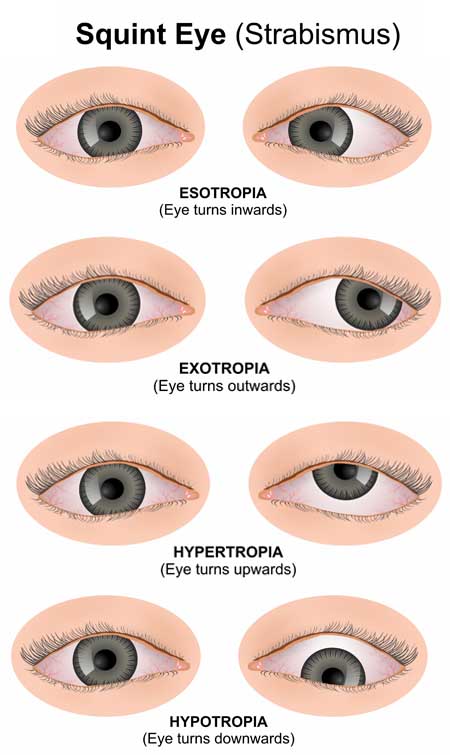
Esotropia/convergent squint
With esotropia, one or both eyes turn inwards towards your nose, which can make you look cross-eyed.
Exotropia/divergent squint
In exotropia, one or both eyes turn outwards, towards your ears.
Hypertropia
With hypertropia, one eye is pointed upwards, towards your forehead.
Hypotropia
In hypotropia, one eye points downwards, towards your chin.
Intermittent squint
As you may have guessed, an intermittent squint comes and goes. Many people find that they get worse when they are stressed or tired.
Consecutive squint
This is the name given to a squint that develops following a previous squint surgery. The most common type is a divergent squint in adults following surgery for a convergent squint in childhood.
What happens if a squint is left untreated?
Even a mild squint can have a significant impact on your vision. If you have a squint that is left untreated, it could result in permanent vision problems, including blurred or double vision, a lazy eye and problems with depth perception that make everyday movement and judgement less safe. For example, you may not be able to correctly judge how far apart steps are to safely move up and down stairs, or how close a travelling car is.
From a psychological perspective, you may also find that you become increasingly less confident in how you look, and in maintaining eye contact with people around you.
Who is suitable for squint surgery?
You may be a good candidate for squint surgery if you have been diagnosed with strabismus, and the position of your eyes is stable, and you don’t have any issues with your eye health, such as an active infection, glaucoma or cataracts. You should also be in good general health.
You will probably be experiencing squint symptoms, such as double vision and headaches, but are unable to get relief by using other treatments.
Who is not suitable for squint surgery?
You may not be suitable for squint surgery if:
- You’ve got an active eye health issue, like moderate to severe dry eye or conjunctivitis
- You have health issues such as active autoimmune conditions, uncontrolled diabetes or other chronic conditions
- Your consultant doesn’t believe that your squint can be corrected using surgery (for example, if you have a progressive neurological disorder)
- The position of your eyes is not stable.
Does squint surgery have an age limit?
No, not really. Both adults and children can have squint surgery, but anyone who is considering the procedure will need to have a consultation to assess their suitability first.
What are the non-surgical alternatives to squint surgery?
Surgery is often a last-resort treatment to correct any condition, and strabismus is no exception. There are a number of alternatives to squint surgery that may be recommended to you before you go down the route of having surgery. These include:
- Prism eyeglasses, which work by bending the light as it enters your eyes in such a way that it compensates for the misalignment and eliminates or reduces double vision
- Strengthening exercises that target the muscles around the eyes to improve their coordination
- Botox injections. These temporarily paralyse the muscles around your eyes to rebalance your eye alignment.
How should I prepare for squint surgery?
Your surgeon and healthcare team will give you some recommendations for the best way to prepare for your strabismus surgery, and following these steps will help to minimise the risk of complications and improve your recovery time as well as your overall outcome from treatment. These steps could include:
- Stopping wearing contact lenses: If you wear contact lenses, you’ll need to stop and switch to glasses. This is usually a week before for soft contact lenses, or two weeks for rigid lenses.
- Medications: If you take any regular medications, you may be advised to temporarily stop some of these or change the dose before your surgery. Your consultant will discuss this with you at your pre-operative assessment.
- Fasting: You’ll be advised to stop eating and drinking for 6 hours before your surgery. This is because you’ll need a general anaesthetic for your procedure. This is where you’re put to sleep. Fasting is necessary to prevent anaesthetic complications.
- Driving: You won’t be able to drive after your surgery, so it’s important to arrange for someone to pick you up and take you home. You’ll be able to go home the same day.
- Go make-up free: The day of your surgery, you should make sure that your face is clean and free from any cosmetics or perfumed moisturiser. We recommend that you wash your hair a day prior, so that you won’t need to do it again for at least a few days, which will help keep your eyes dry during the initial stages of healing.
What happens during squint surgery?
Squint surgery is performed under general anaesthetic, meaning that you’ll be asleep and unable to feel anything during the procedure. This is administered via intravenous injection.
Once you’re asleep, exactly what will happen will depend on the type of strabismus surgery you’re having. After adjustments are made to the muscles around your eye, they will be stitched either temporarily (so they can be adjusted later to fine-tune your treatment) or permanently in place, and you’ll be taken to a recovery room so that you can come around from the anaesthetic. Most of the stitches dissolve and don’t have to be removed (absorbable), but some permanent stitches are used in certain squint operations.
The whole procedure usually takes up to an hour, and once you’ve spent a short time in the recovery suite, you should be able to go home the same day.
Is squint surgery painful?
No, the procedure is done under general anaesthetic, meaning you will be asleep and you won’t feel anything during the surgery. You may experience some discomfort in the days after strabismus surgery, but it’s usually manageable using over-the-counter pain relief. If you have any concerns about pain management, speak to your surgeon and healthcare team.
How long does it take to recover from squint surgery?
You should allow up to 6 weeks to recover from squint surgery, although exact recovery rates can vary depending on your personal circumstances and how closely you follow the post-surgery instructions provided by your healthcare team.
During the first few days, your eyes may feel quite sore, gritty, watery and irritated. Your vision may be blurred, or you may see double. In fact, it could take up to 6 months for your vision to stabilise completely, but you should be able to see clearly enough to go back to work and other normal activities a week or two after your squint surgery.
Your eyes may appear pinky-red for up to 12 weeks or longer if you have had previous squint surgery, but you should avoid wearing any cosmetics until the incisions have healed, which usually takes up to 4 weeks after surgery.
When can I drive after squint surgery?
Many people can get back to driving as soon as 48 hours after their strabismus surgery, but it depends on your individual circumstances. You must meet the minimum legal visual standard for driving and seek advice from your consultant; otherwise it could invalidate your insurance and put others at risk.
When can I exercise after squint surgery?
Most people can get back to their usual exercise activities within 2 weeks of their surgery. However, you should avoid swimming for at least 4 weeks to prevent the risk of irritation and infection. You should also avoid contact sports for 4 to 6 weeks to ensure that your eyes are fully healed.
When can I wear contact lenses after squint surgery?
Again, it depends on your personal circumstances, but your consultant will probably recommend waiting at least 4 to 6 weeks before you start wearing contact lenses again.
What are the possible risks and complications of squint surgery?
Strabismus surgery is generally considered to be very safe, but as with any procedure, there are always some risks and complications to be aware of. These include, but aren’t limited to:
Temporary side effects
- Eye pain, gritty feeling, swelling, watering, redness
- Blood in your tears, which is very common for at least the first few days after surgery
- Itchy, irritated eyes
- Blurred vision, which should get progressively better as your eyes heal.
Risks and complications
- Under or overcorrection of your squint
- Eye muscle slipping out of position
- Infection
- Further surgery
- Double vision
- Complications from the anaesthetic such as dizziness, drowsiness and dry eyes.
Your surgeon will explain exactly what you can expect and what you should be aware of. If you have any concerns at any point, always reach out to your healthcare team.
How much does squint surgery cost at Nuffield Health?
For pricing information, please get in touch with your local hospital. The hospital or your healthcare team will provide you with a fixed, all-inclusive price for the treatment after your initial consultation.
FAQS
-
Will I need more than one squint surgery?
Hopefully not. Although revision squint surgery exists, the aim is to correct your vision enough in a single procedure.
-
Will I still need to wear glasses after squint surgery?
Possibly, yes. Although the surgery may improve some aspects of your vision, such as giving you better peripheral vision, if you have a refractive eye error such as myopia (nearsightedness) that usually requires you to wear glasses, you’ll almost certainly need to wear them still after, although you may find that your prescription changes.
-
Can a squint come back after surgery?
Unfortunately, yes, studies show that strabismus (squint) can potentially return after surgery. The principal reason for this is that strabismus happens because the brain is unable to control eye movements enough to point the eyes in the same direction. Often it is many years or decades before the squint starts returning.
-
Does squint surgery leave a scar?
Your surgeon will do their best to ensure that squint surgery doesn’t leave a scar. In most cases, the incisions will be made into the thin, clear membrane that covers the white of the eye.
-
How long do the results of squint surgery last?
The results of strabismus surgery can last indefinitely, with anecdotal evidence suggesting that people enjoy stable alignment for decades after their surgery. Overall, patient satisfaction remains very high.
Ways to pay
Nuffield Health promise
Our prices are all-inclusive. We will equal any comparable price. There are no time limits on your aftercare.
Paying for yourself
There are no hidden costs in our treatment prices. The price you see is the price you pay.
Find out morePersonal medical loan
Spread the cost of your treatment with a 10, 12 or 24 month 0% personal medical loan.
Find out moreMedical insurance
We work with you and your insurance provider to get you the treatment you need quickly.
Find out more