
Dupuytrens fasciectomy at York Hospital
- Overview
Dupuytren's contracture occurs when thickened, scar-like tissue in the palm gradually pulls one or more fingers towards the hand, making everyday tasks harder. A Dupuytren's fasciectomy is an operation to remove this tissue and help straighten the finger. At Nuffield Health York Hospital, our consultant hand surgeons help restore finger movement and improve hand function.
What is a Dupuytren's fasciectomy?
Dupuytren's fasciectomy is an operation that aims to remove the thickened tissue in your palm and finger causing your fingers to curl towards your palm. Removing this tissue aims to straighten the fingers again and allow you to use your hand more normally.
What else is a Dupuytren's fasciectomy known as?
It is also called a palmar fasciectomy and finger or digital fasciectomy. You may also see it described as Surgery for Dupuytren's contracture.
What are the different types of Dupuytren's fasciectomy?
Surgeons use different approaches depending on how much tissue is affected:
- Segmental fasciectomy: short sections of the thickened cord are removed through one or more small cuts.
- Regional fasciectomy, also called a subtotal palmar fasciectomy: all or most of the diseased tissue is removed through a single longer cut. This is the most commonly used approach.
- Dermofasciectomy: the cord is removed along with the overlying skin. A skin graft (a piece of healthy skin, usually taken from your forearm, upper arm or hip) is stitched in the gap that is created. This is often used when the skin is affected or when the disease has come back (recurrence).
What is Dupuytren's contracture?
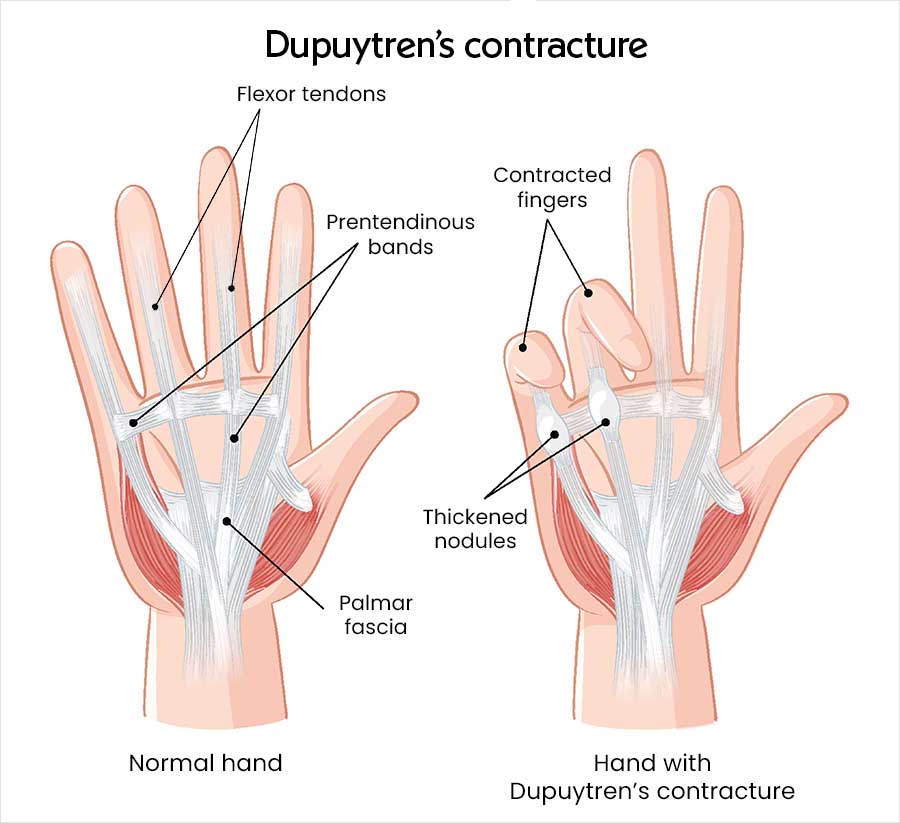
Dupuytren's contracture is a condition that occurs when the tissue between the skin and the tendons in the palm of your hand becomes thickened. The tissue is called the palmar fascia. Over time, it can form firm lumps (nodules) and rope-like bands (cords) that slowly pull one or more fingers into a bent position. It most often affects the ring and little fingers, but can affect any digit. The tendons that move your fingers are not affected.
What causes Dupuytren's contracture, and is it serious?
The cause is not fully understood. It tends to run in families, is more common in men and in people of Northern European background. It has also been linked with diabetes, smoking, alcohol and liver disease, though many people with the condition have none of these.
Dupuytren's contracture is a benign condition and is not dangerous to your health. It often develops slowly over time, but as it progresses, it can make everyday tasks harder, which is when treatment may be worth discussing.
What are the symptoms of Dupuytren's contracture?
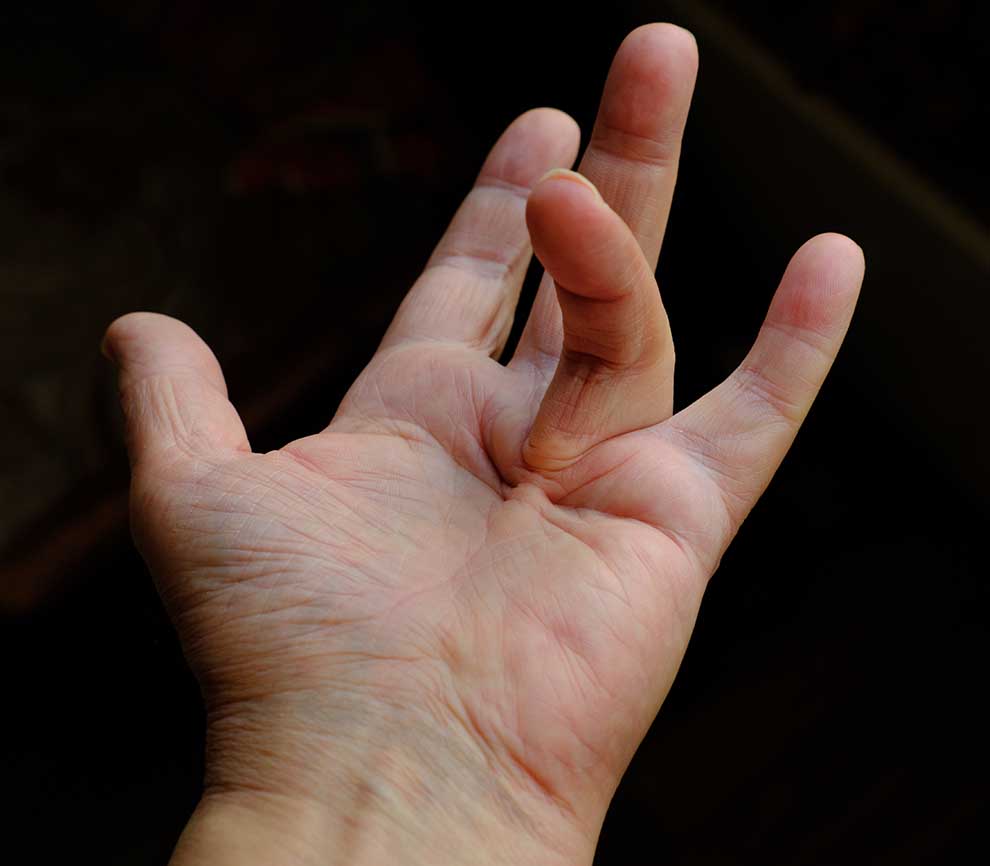
Symptoms usually build up slowly and can include:
- A small, hard lump or nodule in the palm, often near the base of the ring or little finger.
- Dimples, pits or ridges in the skin of the palm.
- Firm cords of tissue under the skin.
- One or more fingers being pulled in towards the palm so they will not fully straighten.
- Trouble laying your hand flat on a table, or difficulty with tasks such as putting on gloves or reaching into a pocket.
The nodules can feel tender in the early stages, but this discomfort usually eases with time. Many people find the condition is not painful.
Who is at risk of Dupuytren's contracture?
Some people are more likely to develop it than others, and there are some associations with other medical conditions. Risk is higher if you:
- Are male.
- Are middle-aged or older, often over 50.
- Have a family history of the condition.
- Have diabetes.
- Smoke or drink a lot of alcohol.
- Have liver disease or take certain epilepsy medicines.
- Those people who work in heavy manual jobs or with vibrating tools.
Having these risk factors does not mean you will get Dupuytren's contracture. They only raise the chance of it developing.
Can Dupuytren's contracture go away on its own?
No. Dupuytren's contracture does not clear up by itself and there is no cure, so it can slowly get worse over time. The speed at which it progresses is hard to predict, and many people never need any treatment.
Why choose Nuffield Health York Hospital for my Dupuytren's fasciectomy
As fingers become more difficult to straighten, everyday tasks can start to feel frustrating and restrictive. At Nuffield Health York Hospital, patients have access to experienced consultant hand surgeons within a hospital that is home to York's dedicated spinal and specialist musculoskeletal services. This multidisciplinary expertise, combined with consultant-led care and advanced diagnostic facilities, helps ensure that patients with Dupuytren's contracture receive a thorough assessment and personalised treatment plan tailored to their needs.
Since opening in 2004, Nuffield Health York Hospital has become a trusted provider of private healthcare for patients across York and North Yorkshire. Located on Haxby Road, the purpose-built hospital brings together surgery, physiotherapy, diagnostic services and rehabilitation within one location. Following a Dupuytren's fasciectomy, patients can benefit from specialist physiotherapy support, while convenient facilities including an on-site pharmacy, free parking and modern diagnostic services.
How to book a consultation at Nuffield Health York Hospital?
Not sure whether your Dupuytren's contracture has reached the stage where surgery is needed? An experienced hand specialist can assess your symptoms, examine your hand and explain the treatment options available. Book an online appointment at Nuffield Health York Hospital, get in touch using our enquiry form or speak to our team on 01372 233890.
When might I need a Dupuytren's fasciectomy?
Surgery is usually considered once the contracture is affecting how you use your hand, for example, when you can no longer lay your hand flat on a table. It may be recommended when your fingers cannot be straightened by other treatments, or when the bend is making daily tasks difficult. Results tend to be better when surgery is done before a finger becomes very bent.
Who is suitable for a Dupuytren's fasciectomy?
A fasciectomy may suit you if the contracture is far enough along to limit your hand, such as not being able to flatten your hand on a surface, and if it is affecting your quality of life.
A surgeon will examine your hand, confirm the diagnosis and talk through whether an operation is the right step for you and when to have it.
Who is not suitable for a Dupuytren's fasciectomy?
Surgery is generally not offered while the disease is mild, your hand still works well and your fingers can still be straightened. In the early stages, treatment tends not to be effective, and leaving the condition alone is often the better choice. Unfortunately, there is no cure for the condition and the timing of surgical treatment is often a balance.
Certain things raise the chance of problems and your surgeon will weigh them up with you, including smoking, a higher body weight, diabetes and arthritis in the finger joints. Please treat this as general information and speak to your surgeon about your own situation.
What are the alternatives to a Dupuytren's fasciectomy?
Depending on how advanced your condition is, other options may include:
- Adopting a wait-and-see approach: often best for mild disease that is not limiting your hand.
- Needle fasciotomy (also called percutaneous needle fasciotomy or needle aponeurotomy): a needle or fine blade is used to cut or snap the cord and release the finger. This does not remove the disease, but only divides the cord.
- Steroid injection: sometimes used to ease the discomfort of early nodules. They do not affect the progress of the disease.
- Amputation of a finger: only for very severe contractures, repeated recurrence, or nerve or blood-vessel damage.
Percutaneous needle fasciotomy (PNF) versus Dupuytren's fasciectomy
With a needle fasciotomy, a needle or fine blade cuts through the cord to free the finger. This is usually performed under local anaesthetic and often with a very quick recovery. Many people notice an improvement straight away, but the condition is much more likely to return, and the procedure may need repeating. Some patients may get a small tear to the skin as the finger is straightened. This usually heals very quickly without complication.
Dupuytren's fasciectomy is a bigger operation that removes a section of the thickened tissue rather than simply cutting it. Recovery takes longer, but the results tend to last longer and the disease comes back less often.
How can I prepare for a Dupuytren's fasciectomy?
Once you have a date, a few steps help things go smoothly:
- Take off any rings and keep your hands clean, with nails trimmed.
- Arrange for someone to drive you home, and ideally to stay with you overnight.
- Stop smoking, as it delays healing.
- If you have diabetes, keep your blood sugar steady to lower the risk of infection.
- Tell the team about all your medicines and allergies. You may have to temporarily stop certain medicines before surgery.
- Plan for the first few days at home, for example by preparing easy meals in advance.
Whether you need to stop eating and drinking beforehand depends on your anaesthetic - your medical team will tell you what to do.
What happens at my pre-operative assessment?
If you are having a regional or general anaesthetic, you will usually attend a pre-assessment appointment beforehand. This checks your general health to make sure you are ready for admission, treatment, and going home afterwards.
Bring a list of all your current medicines, along with any allergies and the reactions they cause. Your medical team will also tell you which medicines, if any, you should reduce or stop before surgery. Read your appointment letter and instructions closely before the day.
What should I bring on the day of my Dupuytren's fasciectomy?
Keep what you bring simple:
- A list of your medicines and any allergies.
- Your appointment letter and any instructions you were sent.
- If you will be awake for the operation, headphones and a device to listen to music or watch something, if you would like to.
Have a bath or shower before you come in and remove any rings beforehand. Make sure someone can take you home afterwards.
What should I expect during a Dupuytren's fasciectomy?
The operation is usually a day case, so you go home the same day. The operation usually takes somewhere between 20 minutes and 2 hours, depending on how complex the disease is.
Dupuytren’s fasciectomy follows these steps:
- You are given a local, regional or general anaesthetic. A local numbs just the hand, a regional numbs the whole arm while you stay awake, whereas a general anaesthetic sends you to sleep.
- If you are awake, a tight band (a tourniquet) may be put around your upper arm for a short time to stop the blood flow while the surgeon works.
- The surgeon makes one or more cuts, often in a zig-zag shape, along your palm and finger.
- The thickened cords and nodules are removed. If needed, a skin graft is stitched in to fill a gap or replace poor skin.
- The cuts are closed with stitches and your hand is wrapped in a bulky dressing, and you are usually given a sling.
Is a Dupuytren's fasciectomy painful?
You should not feel pain during the operation itself, because your hand or arm is numbed or you are asleep. Afterwards, your hand may feel sore and swollen, and you may have some discomfort and stiffness, but this can usually be managed with simple painkillers and tends to settle over the first few weeks.
How long does it take to recover after a Dupuytren's fasciectomy?
In hospital: A fasciectomy is normally a day case, so almost everyone goes home the same day. Your hand will be in a bulky dressing, and sometimes placed into a plaster cast. You will usually have a sling. The nurses check that you have recovered enough from the anaesthetic before you leave, and you should have someone to take you home and stay with you overnight.
At home: Keep your hand raised above your elbow, especially for the first 2 to 3 days, to control swelling, and do not let it hang by your side. Keep the dressing dry and wiggle your fingers to help prevent stiffness. Your wound is usually reviewed about a week later, and the stitches come out around 12 to 14 days after surgery.
Wounds tend to heal within about 2 to 3 weeks, with fuller recovery often taking 4 to 12 weeks.
More severe cases, or those needing a skin graft, can take around 3 months or longer, and hand therapy or a night splint may be recommended for some people.
When can I return to work after a Dupuytren's fasciectomy?
Many people return to office-based work in about 2 to 3 weeks, while heavier or more physical jobs may need 6 to 8 weeks. Depending on the job and how you heal, time off can range from about 2 to 12 weeks.
When can I drive after a Dupuytren's fasciectomy?
You can usually drive once your wound has healed and you can make a full, pain-free fist and safely grip the wheel with both hands, often around 3 to 4 weeks. Please check with your car insurer. Ultimately, you, as the driver, are responsible for being safe to drive.
When can I shower or bathe after a Dupuytren's fasciectomy?
You can wash normally once the wounds have healed, but keep the hand dry before then. Washing up and swimming are best avoided until healing is complete, usually around 3 to 4 weeks.
What should I avoid after a Dupuytren's fasciectomy?
While your hand heals, it helps to:
- Avoid letting your hand hang down by your side.
- Avoid getting the dressing or wound wet and try not to disturb the dressing until you are told you can.
- Avoid heavy or repetitive use of the hand until your wound has healed and you have been advised it is safe.
- Avoid forcing your fingers straight if they are stuck in a bent position.
What are the benefits of a Dupuytren's fasciectomy?
The main benefit is a straighter finger and better use of your hand, which can also ease discomfort and slow the effects of the disease. Compared with smaller treatments, a fasciectomy tends to give a longer-lasting result.
You may notice your finger is straighter soon after the operation, but the full benefit builds up as your hand heals. Regular exercises and hand therapy are often recommended to help you maintain the improvement and regain movement.
How long do the effects of a Dupuytren's fasciectomy last?
Surgery improves how your hand works but does not cure Dupuytren's disease, so the contracture can return in the same finger or appear elsewhere in the hand.
How likely this is to return depends on the type of procedure you have, which joints were affected, and how straight your finger was afterwards.
Around five years after treatment, it has come back in about 25% of people who had a fasciectomy.
What are the risks and complications of a Dupuytren's fasciectomy?
All surgeries carry some risk. Serious problems are uncommon, and the risk tends to rise with more severe disease and with repeat operations on the same finger.
General complications can include:
- Pain
- Bleeding
- Infection of the wound
- Bruising and swelling
- Scarring and scars that stay tender for a while.
Complications more specific to this surgery can include:
- Injury to a nerve, causing numbness or loss of feeling in the finger, which may be temporary or, rarely, permanent
- Injury to an artery in the finger
- Incomplete straightening of the finger
- Return of the contracture
- Stiffness of the finger joints
- Wound-healing problems, including the wound opening up
- Failure of a skin graft to fully take
- Cold intolerance in the finger
- Complex regional pain syndrome: a rare problem causing lasting pain, stiffness and swelling in the hand
- Amputation of a finger: a rare outcome, mainly in very severe or repeat cases.
Your surgeon will talk through the risks that apply to you before you agree to the operation.
How much does a Dupuytren's fasciectomy cost at Nuffield Health York Hospital?
To find out more about the cost of a Dupuytren's fasciectomy at Nuffield Health York Hospital, contact our team on 01372 233890. The hospital or your healthcare team will give you a fixed all-inclusive price for the treatment following your initial consultation.
FAQs
-
Is Dupuytren's contracture hereditary?
It often runs in families, so if a parent or grandparent has it, you have an increased likelihood of developing the condition yourself. However, not everyone with a family history will develop it, and it can also appear in people with no relatives affected.
-
What questions should I ask my surgeon before a Dupuytren's fasciectomy?
- How straight is my finger likely to be afterwards?
- How likely is it to come back?
- What are the risks in my case?
- How long before I can drive, work and return to my usual activities?
It's also worth asking whether a less invasive option such as needle fasciotomy would suit you, and what would happen if you chose to wait.
-
What if my Dupuytren's fasciectomy doesn't work?
If your finger doesn't straighten as much as hoped, or the contracture returns, further treatment might be possible, including repeated surgery or a dermofasciectomy (removing the affected tissue along with the overlying skin, replaced by a skin graft). Not everyone whose contracture comes back needs or wants another procedure, as symptoms are often mild enough to live with. This would warrant further discussion with your surgeon.
-
Will I need hand therapy or physiotherapy after a Dupuytren's fasciectomy?
Yes, most people see a hand therapist after surgery for exercises to restore movement and help the scar heal well. Following the exercise programme closely can make a real difference to your final result.
Dupuytrens fasciectomy consultants at York Hospital
Haxby Road, York, YO31 8TA
Ways to pay
Nuffield Health promise
Our prices are all-inclusive. We will equal any comparable price. There are no time limits on your aftercare.
Paying for yourself
There are no hidden costs in our treatment prices. The price you see is the price you pay.
Find out morePersonal medical loan
Spread the cost of your treatment with a 10, 12 or 24 month 0% personal medical loan.
Find out moreMedical insurance
We work with you and your insurance provider to get you the treatment you need quickly.
Find out more